In This Article
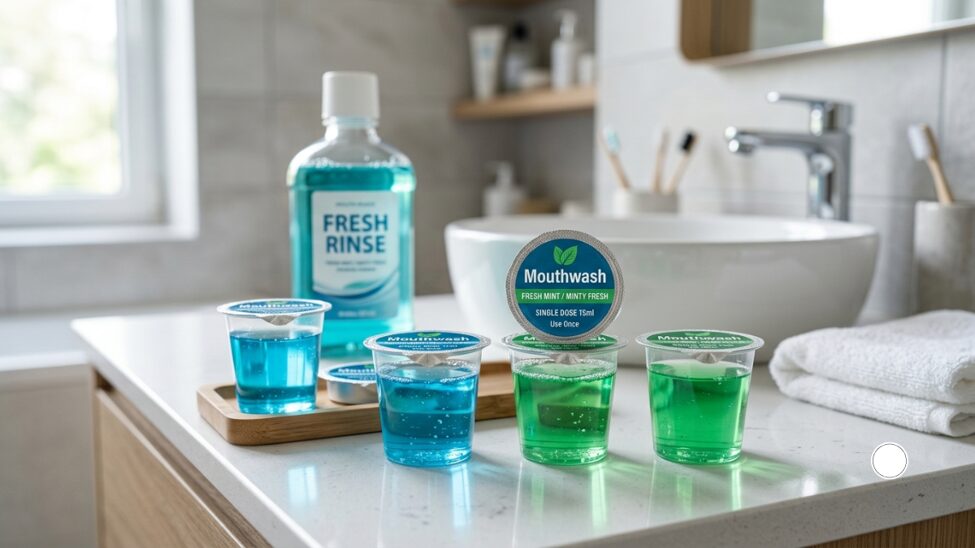
Most buyers are familiar with bottled mouthwash, but single-dose cups have become a genuinely practical format for hospitality, healthcare, travel, and promotional applications.
Before choosing this format, though, you need to understand how it differs from bottled production in terms of manufacturing requirements, production scale, and where it actually makes commercial sense.
This article covers how single-dose mouthwash cups are manufactured, where they are commonly used, what MOQ and cost look like, and the situations where this format works and where it does not.
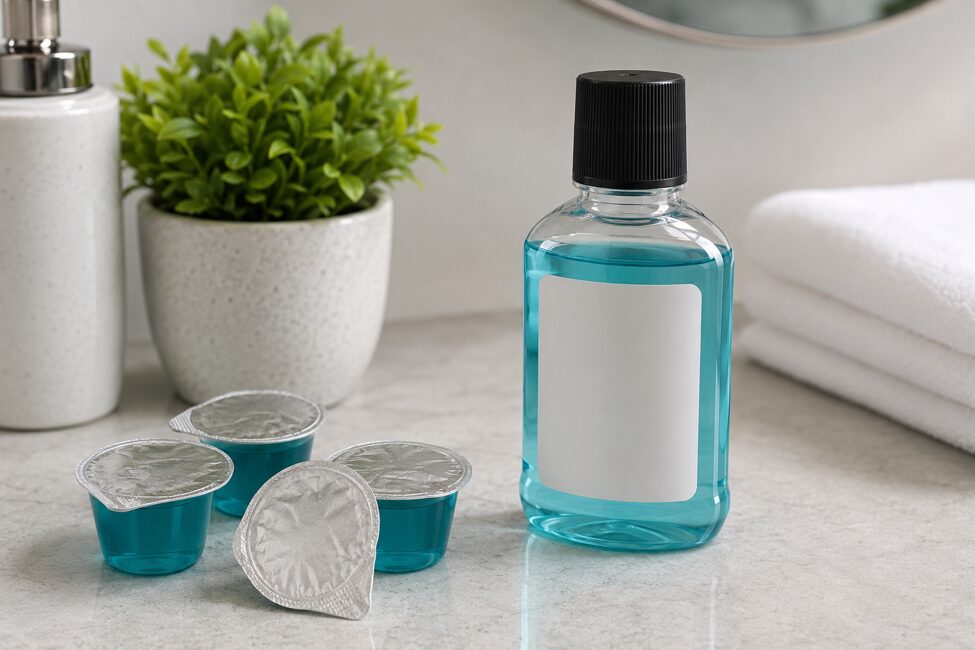
Single-dose mouthwash cups are pre-measured, single-use containers filled with a set volume of mouthwash and sealed with a foil lid.
Unlike a bottle that a consumer opens and uses repeatedly over time, each cup contains exactly one use and is discarded after opening. The format is built around portion control, hygiene, and convenience rather than everyday repeated use at home.
From a manufacturing standpoint, single-dose cups follow a completely different production route from bottled mouthwash.
They require dedicated cup-filling and heat-sealing equipment rather than the conventional bottle-filling lines used for standard mouthwash manufacturing. That distinction matters for planning, and the sections below explain exactly why.
Single-dose mouthwash cups are used in environments where hygiene, portion control, and standardized dosing are operational requirements rather than nice-to-haves. The format is selected because of how the product is distributed and used, not simply because it is portable.
Common applications include the following:
The common thread across all of these is that the buyer is distributing the product in a controlled environment and needs the format to behave predictably across every unit. That is what single-dose cups are built to do.
Single-dose cup production does not simply take the same mouthwash that goes into a bottle and package it differently. It is a distinct manufacturing process that runs on different equipment and involves different production planning entirely.
Here is how the process works from our end:
Cups are formed using thermoforming equipment that shapes each individual cup from a plastic sheet. Once the cups are formed and loaded into the filling system, the mouthwash formula is dispensed into each cup at a precise, pre-set volume.
The filled cups then move through a heat-sealing station where a foil lid is applied and sealed across the top of each cup to create an airtight, tamper-evident closure.
Foil lid production, cup tooling, and carton configuration all have to be planned and confirmed before a production run can begin. The tooling that forms the cups needs to be set up specifically for the cup dimensions your project requires, and the foil sealing parameters need to be calibrated to your formula and fill volume.
These are not adjustments that happen on the fly during a production run. They are engineering decisions that get locked in during project setup, which is part of why this format has the MOQ requirements it does.
Single-dose mouthwash cups require higher production volumes than bottled mouthwash, and the reasons for that sit directly in the manufacturing process described above.
The approved production data for this format is as follows:
The MOQ starts at around 100,000 units because thermoforming tooling, foil lid production setup, and the efficiency thresholds of automated filling and heat-sealing systems all require a minimum viable production volume to operate economically.
Thermoforming lines run most efficiently at high throughput and setting up the foil sealing system carries fixed costs that need to be distributed across enough units to make the run viable. Running below these thresholds pushes per-unit costs to a level that does not make commercial sense for either side.
These figures are indicative and vary depending on your formula, cup dimensions, foil specification, carton configuration, and shipping destination.
The broader cost factors behind mouthwash manufacturing are covered in the mouthwash cost guide, which goes deeper into what drives pricing across different project types.
For MOQ planning specifically, our mouthwash MOQ guide explains the production economics behind minimum order requirements in more detail.
From a manufacturing and commercial standpoint, single-dose cups offer specific advantages that make them the right choice for the applications they are designed for.
Here is where the format genuinely outperforms bottles:
Bottled mouthwash remains the stronger choice for retail shelf presence, everyday consumer use, and any project where a lower MOQ is a requirement. That format is covered separately, but the comparison is worth keeping in mind when deciding which production route fits your project.
Single-dose cups are a practical format for the right application, but they are not the right choice for every project. Understanding where the format falls short is part of making a good manufacturing decision.
Single-dose mouthwash cups are generally not the right fit in these situations:
The most appropriate packaging format for any project comes down to manufacturing feasibility, production scale, and how the product is going to reach the end user.
Choosing a format simply because it looks convenient or on-trend without accounting for those factors tends to create production planning problems later.
Requesting a quotation comes naturally after vetting your private label mouthwash manufacturer. However, when you do reach out for that quote, it is much better to be specific with your project information.
Vague inquiries only produce vague estimates. With a format like single-dose cups where tooling and setup decisions are locked in early, starting with incomplete details often means restarting conversations later.
Before requesting a quotation, have the following ready:
Providing this information upfront allows manufacturers to assess production feasibility, identify any tooling or setup considerations specific to your project, and give you a quotation that reflects your actual project rather than a generic estimate.
You can see how these preparation steps came together in a real production scenario in our mouthwash cup OEM case study, which walks through how a single-dose cup project moved from specification through to production.
The typical MOQ for single-dose mouthwash cups is around 100,000 units. This reflects the thermoforming tooling requirements, foil lid production setup, and the efficiency thresholds of automated filling and heat-sealing systems.
Bottled mouthwash runs on conventional filling lines that are more flexible at lower volumes. Single-dose cup production requires dedicated thermoforming equipment, foil sealing systems, and tooling setup that only become economically viable at higher production volumes.
Yes. Hotels and airlines are among the most common buyers of this format. The portion-controlled, sealed, single-use nature of the cup fits the hygiene standards and amenity kit requirements of both industries.
The indicative FOB cost for single-dose mouthwash cups runs around USD 0.08 to 0.15 per unit. The actual figure for your project depends on cup dimensions, foil specification, formula, and order volume.
Yes. Cup dimensions, foil lid design, and carton configuration can all be customized within the constraints of the tooling setup. Artwork for the foil lid and outer carton can be developed to your brand specifications.
Single-dose mouthwash cups are a purpose-built format for specific commercial applications.
They require different equipment, different production planning, and higher minimum order volumes than bottled mouthwash. They perform best in distribution environments where portion control, hygiene, and standardized dosing are genuine requirements rather than optional features.
At ORALABX, we work with brands before production begins to assess whether single-dose packaging fits their volume, cost structure, and distribution model.
If you’re evaluating single-dose packaging for your next project, ORALABX can help determine whether this format matches your production volume, distribution model, and commercial objectives.
Reach out to our team and we will take it from there.

Share your product type, target market, estimated volume and launch timeline. We will review the project scope and recommend the appropriate development path.
Best suited to brands, importers and distributors planning scalable commercial production.