In This Article
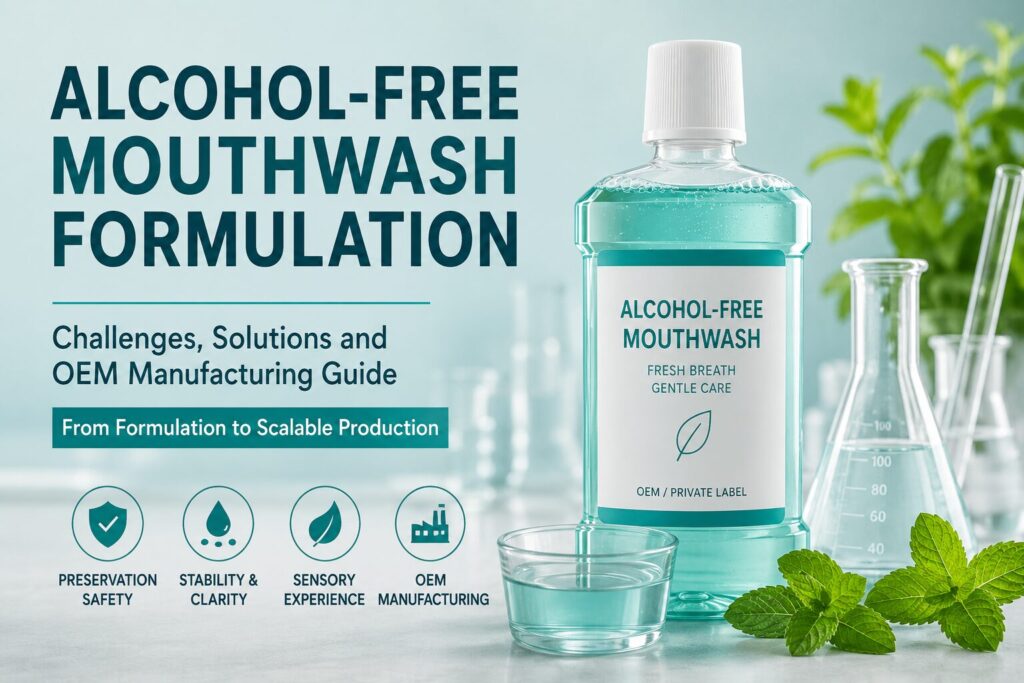
Alcohol-free mouthwash has become one of the fastest-growing categories in oral care. Brands increasingly request formulations that deliver effective fresh-breath performance without the burning sensation associated with ethanol.
Removing alcohol, however, is far more complex than simply deleting one ingredient. Ethanol acts as a solvent, a preservation aid, and a sensory component. Once it is removed, the manufacturer must redesign the entire formulation system to maintain stability, clarity, preservation, and consumer acceptance.
This guide explains the most common alcohol-free mouthwash formulation challenges and how experienced OEM manufacturers address them during commercial product development. It is written for brand owners, product managers, and procurement teams evaluating an alcohol-free launch — not as a laboratory paper. Rather than focusing on laboratory theory alone, this guide explains how these formulation challenges are addressed during real OEM manufacturing and commercial production.
Three commercial forces are driving the shift. First, sensory preference: a large share of consumers reject the sting of alcohol-based rinses, especially users with sensitive gums, dry mouth, or those rinsing twice daily — for daily-use positioning, mildness is now a selling point rather than a compromise. Second, lifestyle positioning: kids’ lines, halal-conscious markets, natural and clean-label brands, and pregnancy-safe positioning all effectively require an alcohol-free base. Third, channel expectations: on e-commerce platforms and in pharmacy aisles, “alcohol-free” has become a default filter term, so a range without it looks incomplete.
The practical consequence for OEM buyers is simple: most new private label mouthwash projects we receive today specify alcohol-free from the first brief.
In a traditional mouthwash, ethanol quietly performs several jobs at once. As a solvent it dissolves flavor and essential oils — mint, eucalyptol — that are not water-soluble, keeping the liquid clear. As a preservation aid it suppresses microbial growth, reducing the load on the preservative system. As a sensory signal its characteristic “bite” is read by many consumers as proof the product is working. And by keeping oils in solution it maintains physical stability, preventing clouding, precipitation, and phase separation.
Remove ethanol and all four functions must be re-engineered at the same time, using ingredients that interact with one another. This is why a well-made alcohol-free formula is a system-balancing exercise, not an ingredient swap — a point that runs through every section below.
Once ethanol is removed, antibacterial protection drops sharply, and a single preservative is often not enough to keep the product safe across its shelf life. In real OEM projects we have seen preservation fail outright — a formula that passes at release loses its antibacterial performance in storage because of an unsuitable preservative choice or a pH shift, sometimes ending in spoilage.
The working solution is a multi-preservative system. Different preservatives cover different parts of the microbial spectrum — some act mainly on bacteria, others on yeast and mold — so combining preservatives with complementary mechanisms widens coverage and improves reliability, while letting each one be dosed lower to reduce irritation and bitterness. In commercial OEM development, a combination of sodium benzoate and potassium sorbate has repeatedly delivered stable performance; by contrast, formulas that lean heavily on humectant systems such as propylene glycol with sorbitol tend to show weaker preservation.
Both of those preservatives only reach full activity in a mildly acidic environment — generally below pH 6 — which is why preservation and pH must be designed together. As pH rises, their antimicrobial power falls and microbial risk climbs. Preservation also depends on what happens outside the formula: production water quality, sanitized filling lines, and controlled microbiological limits at release. A correct preservative system cannot compensate for uncontrolled process water.
Without ethanol, formulas become far more sensitive to temperature and time. The most common failure is turbidity — both high and low temperatures reduce the solubility of dissolved components, causing precipitation or cloudiness, and this is amplified in alcohol-free systems because ethanol no longer aids dissolution and dispersion. The same pH window that governs preservation also governs stability: deviation from the target range pushes poorly soluble components toward precipitation and phase separation.
The important lesson from production is when instability appears. A formula is often perfectly clear at initial testing and only becomes unstable after temperature cycling, or after roughly 30 days or more of real storage. Week-one clarity proves very little; the honest test is what the product looks like after thermal stress and a month on the shelf. Reduced raw-material compatibility after ethanol removal is the root cause — the system now leans on solubilizers and dispersants, and when external conditions change, that colloidal balance is easily disrupted.
This is the most visible challenge. Flavor and essential oils must be held in clear solution without ethanol, which is achieved with non-ionic solubilizers and mild surfactants dosed at a precise ratio to the flavor load. The balance is unforgiving in both directions: too little and the product turns hazy or separates; too much and the excess flattens the flavor, adds unwanted mouthfeel, or produces foaming.
Natural extracts and complex fragrance systems are especially difficult to stabilize, which is why changing a fragrance house or flavor variant in an alcohol-free system is never a “drop-in” substitution — it forces re-optimization of the solubilizer system and fresh stability testing.
Consumers equate intensity with efficacy. Remove the alcohol bite and an otherwise excellent formula can be perceived as weak, watery, or lacking the “strong” taste buyers expect — and in poorly balanced formulas a faint end-of-rinse bitterness can appear. pH plays into this too: too low irritates, too high turns bitter, with a slightly acidic range near natural oral conditions giving the best balance of mildness and taste.
Experienced formulators rebuild the sensory profile deliberately. Glycerin is the workhorse: it binds water through hydrogen bonding to keep the mucosa hydrated and reduce post-rinse dryness, acts as a polar co-solvent to help disperse poorly soluble ingredients, and slightly raises viscosity to improve mouthfeel — though its level must be controlled, since excess glycerin harms clarity and taste. Cooling is rebuilt with menthol and modern cooling agents to recreate freshness without irritation, supported by a balanced sweetness system, typically xylitol or sorbitol. One subtle risk is flavor chemistry: certain aroma components such as aldehydes can become more prominent once ethanol is gone, producing an unbalanced note. The upside is decisive — with no ethanol there is no burning sensation, making the product genuinely suitable for children, sensitive users, and long-term daily use.
For a first-time brand, the four challenges above look like four separate R&D projects. For an experienced OEM manufacturer they are one integrated development pathway that has already been walked many times.
Mature manufacturers maintain validated base systems — preservation, buffering, and solubilization frameworks that have already passed challenge testing and long-term stability in commercial production. New projects customize actives, flavor, and positioning on top of a validated chassis instead of starting from a blank beaker. This is the core logic behind custom mouthwash formulation at OEM level: customization within a validated system, not experimentation at the customer’s expense.
They also carry ingredient-interaction knowledge learned through production history rather than literature — which preservative pair stays active across the target pH, how a flavor oil behaves with a given solubilizer, how a humectant-heavy base affects preservation. Factory-level validation then confirms the lab formula survives real process conditions: a formula that behaves in a 2-liter beaker can behave differently in a multi-ton tank, where mixing shear, temperature profile, dissolution order, and water system all change, so pilot batches run before any commercial commitment. Finally, production discipline — batch records, in-process pH and appearance checks, microbiological release testing, and retained samples — makes the hundredth batch match the first. For a brand, formulation capability without production discipline is only half a supplier. This combination of formulation knowledge, production validation, and manufacturing discipline is what separates commercial OEM development from laboratory formulation alone.
Before an alcohol-free mouthwash reaches commercial release, a serious OEM program runs it through a defined test structure:
Brands evaluating suppliers should ask to see this testing structure, not just a finished sample. A finished sample demonstrates initial performance, while a structured validation program demonstrates long-term manufacturing reliability.
Regulatory treatment depends on the target market and the claims made.
In the European Union, mouthwash is generally regulated as a cosmetic under Regulation (EC) 1223/2009. Preservatives must be approved substances used within their permitted concentration limits — one more reason a compliant multi-preservative system is often the practical route — and every batch must meet the applicable microbial limits for oral care products. Requirements can vary slightly between member states, so the design must account for the specific target market.
In the United States, classification depends on claims. Cosmetic-claim rinses fall under FDA cosmetic requirements including MoCRA-era obligations, while therapeutic claims such as anticavity move the product into OTC drug territory. Brands targeting the US should review whether FDA registration is needed to launch a mouthwash brand before finalizing claims.
Other markets — Gulf states, Southeast Asia, and elsewhere — apply their own notification, ingredient, and labeling rules, and halal considerations often reinforce the alcohol-free choice itself. The practical takeaway: define your target markets before the formula is frozen, because preservatives, pH, and labeling must be designed for the strictest market you intend to enter.
After years of alcohol-free development projects, one pattern repeats constantly: most first-time brands focus on active ingredients, while experienced manufacturers first focus on formulation balance.
Two mistakes recur. The first is validating stability only at room temperature; real products face high-temperature storage and low-temperature transport, where turbidity, precipitation, and separation surface. The second is overloading the formula with plant extracts or extra actives to strengthen marketing claims — which almost always makes the system harder to control and more prone to failure. The brands that launch smoothly treat the formula as a balanced system: they lock target market and claims first, accept validated base systems where differentiation adds no value, and spend their customization budget where consumers can actually perceive it — actives, flavor identity, and packaging. Successful commercial projects usually simplify formulation before adding complexity.
Is alcohol-free mouthwash less effective than alcohol-based?
No — efficacy comes from the active system and formulation design, not from ethanol. Alcohol contributes sensation, not the primary function of a well-designed rinse.
Why did my previous alcohol-free sample turn cloudy?
Almost always a solubilization or stability issue — the solubilizer-to-flavor ratio was not optimized for that flavor oil, or the formula was never validated through temperature cycling. It is a solvable engineering problem, not an inherent limit of alcohol-free systems.
Why do alcohol-free mouthwash formulas require more development time?
Removing ethanol requires manufacturers to redesign preservation, solubilization, stability, and sensory systems together. Additional formulation validation and stability testing are therefore required before commercial production.
Can any flavor be used in an alcohol-free system?
Most flavor directions are achievable, but high-oil-load or natural-extract flavors require re-optimization of the solubilizer system and re-testing. Flavor should be selected inside the development process, not after the base is frozen.
Do alcohol-free formulas have a shorter shelf life?
Not when the preservative system is properly designed and challenge-tested. Shelf life is set by the validated system as a whole — formula, packaging, and process — not by the presence or absence of ethanol.
Brands can choose between a validated stock formulation or a fully custom alcohol-free formulation depending on their launch objectives — we compare both in our guide to stock formula vs custom formula for mouthwash. For realistic stage-by-stage planning, see the mouthwash development timeline. When comparing suppliers, our guide on how to evaluate a private label mouthwash manufacturer covers the full document checklist, and the private label mouthwash cost guide explains how formulation choices translate into unit economics.
Developing a stable alcohol-free mouthwash requires more than removing ethanol. Successful commercial products depend on formulation balance, validated manufacturing processes, packaging compatibility, and regulatory compliance — engineered together, from the first brief.
Whether using a validated stock formula or a fully custom development program, successful alcohol-free mouthwash manufacturing depends on balancing formulation science with scalable production.
At ORALABX, we help brands develop alcohol-free mouthwash formulations from concept to commercial production, combining formulation expertise with scalable OEM manufacturing. As a private label mouthwash manufacturer with validated alcohol-free mouthwash manufacturing systems, we support both stock-formula launches and fully custom development.
Planning an alcohol-free launch? [Request a formulation consultation →]
About ORALABX — ORALABX develops private-label and OEM oral care products for international brands, supporting projects from formulation development through commercial manufacturing.
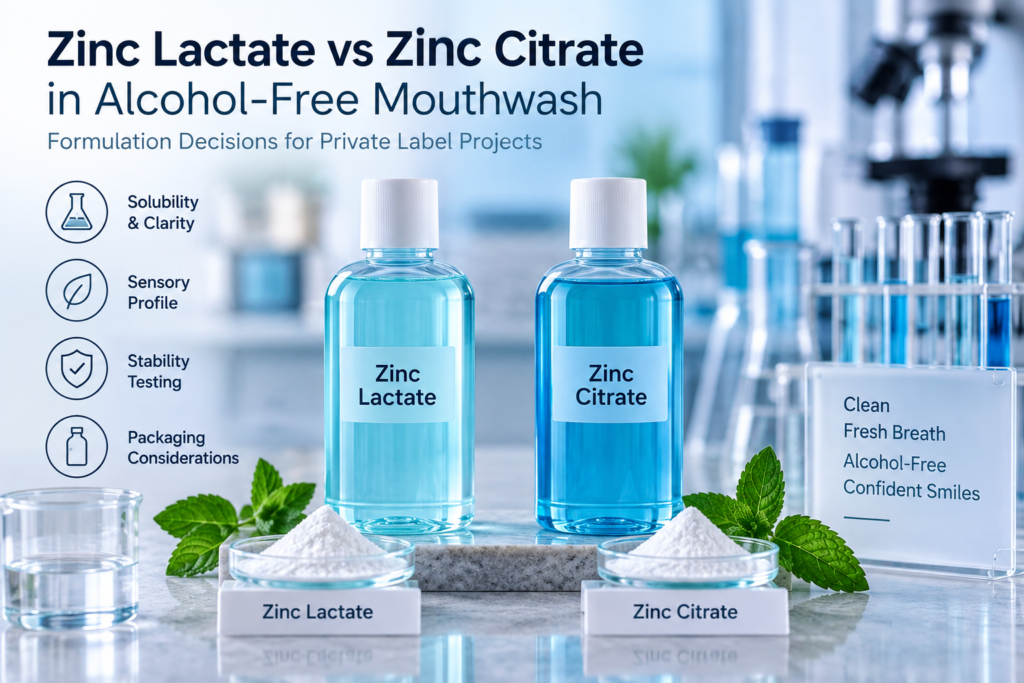
For private label fresh-breath mouthwash, zinc citrate combined with xylitol is a practical alcohol-free formulation direction. The development work is not limited to adding a zinc ingredient. The manufacturer must balance zinc level, solubility, clarity, flavor masking, sweetness, pH, preservation, and the intended packaging system so that the finished product remains commercially consistent.
ORALABX uses zinc citrate plus xylitol as the primary zinc-based route for qualified cosmetic mouthwash projects. Zinc PCA is evaluated only when a defined product brief or market requirement justifies it. Positioning should remain within cosmetic fresh-breath and daily oral-care language unless the brand has separately confirmed a different regulatory pathway.
These decisions should be reviewed together rather than after the formula is finalized. See our alcohol-free mouthwash manufacturing program and custom mouthwash formulation process.

Share your product type, target market, estimated volume and launch timeline. We will review the project scope and recommend the appropriate development path.
Best suited to brands, importers and distributors planning scalable commercial production.