Breath Spray

22 min read
July 31, 2026
Breath Spray
22 min read
July 31, 2026
In This Article
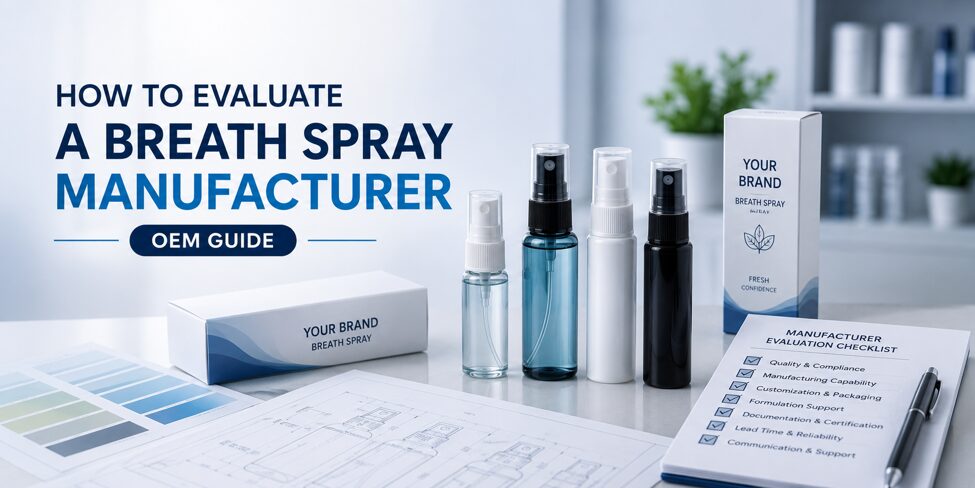
Choosing a breath spray manufacturer involves more than comparing production capacity, certifications, or quotations. Breath spray products require a manufacturer that can coordinate formulation development, packaging, filling, and commercial preparation as part of a single manufacturing process.
Because these elements are closely connected, evaluating one area without considering the others rarely gives a complete picture. Buyers should understand how an OEM partner manages their specific project before moving into sample development or commercial production.
This guide explains the key capabilities to evaluate before selecting a breath spray manufacturer. If you’re still exploring the category, start with How to Launch a Private Label Breath Spray Brand before comparing OEM partners.
Not all oral care products present the same manufacturing challenges. While toothpaste and mouthwash each have their own production requirements, breath spray relies on the successful coordination of the formulation and the dispensing system.
A manufacturer should be able to develop these elements together so the finished product performs as intended.
This is one of the main reasons experience producing mouthwash does not automatically translate into expertise in breath spray manufacturing. Although some mouthwash products use controlled dispensing closures or pumps, conventional bottled mouthwash typically involves a different fill volume and packaging system from breath spray.
Breath spray projects generally require closer coordination between the low fill volume, pump output, spray pattern, bottle-to-pump fit, and leakage control to support reliable product performance and commercial production.
When evaluating an OEM partner, buyers should look beyond general oral care experience and assess how the manufacturer manages the complete breath spray system. Important areas to evaluate include:
Evaluating these capabilities together provides a more accurate picture of a manufacturer’s ability to deliver a successful breath spray product. The rest of this guide explains how each area contributes to a thorough breath spray manufacturer evaluation.
Formula development is one part of creating a successful breath spray product. Manufacturers should also be able to balance flavour performance, ingredient compatibility, and packaging requirements so the finished product performs reliably throughout development and commercial production.
These decisions are closely connected. For example, changing an ingredient may influence sensory intensity, solubility or product clarity, compatibility with the selected pump system, dispensing behaviour, or interactions between the formulation and packaging materials.
Likewise, selecting a different pump system may require adjustments to the formulation to maintain consistent product performance. Evaluating these factors together helps reduce development issues later in the project.
When assessing a manufacturer’s development capability, consider whether they can:
A capable private label oral spray supplier should be able to explain how these decisions are managed throughout the project, rather than treating formulation, flavour, and packaging as separate stages.
If you’d like to learn more about flavour stability and sensory performance, read The Science of Fresh Breath Sprays: Volatility, Flavor Binding & Shelf Life.
Packaging plays a much bigger role in breath spray manufacturing than it does in many other oral care products. The bottle, pump, and formulation must work together to deliver the intended spray pattern, output per actuation, dispensing consistency, and overall user experience.
Evaluating these components as a complete dispensing system provides a better indication of a manufacturer’s technical capability.
An experienced OEM partner should be able to recommend packaging that is compatible with the formulation rather than selecting components based only on appearance or cost. They should also understand how bottle, pump, and filling decisions affect production efficiency and product performance after launch.
When evaluating a manufacturer’s packaging experience, consider whether they can:
A capable OEM breath spray factory should demonstrate experience coordinating the complete dispensing system, not simply supplying individual packaging components. This approach helps reduce compatibility issues and supports more reliable commercial production.
Developing a successful breath spray is only part of the process. A manufacturer should also be able to produce the product consistently throughout commercial manufacturing. For breath spray, this means maintaining accurate fill volumes, reliable pump performance, and consistent product quality across every production batch.
Low-fill production requires careful process control because manufacturers need to maintain consistent net content, reliable pump assembly, closure integrity, leakage control, and uniform product appearance from batch to batch.
They should also have quality control procedures in place to verify formula consistency, conduct appropriate production sampling or in-process quality checks, and identify potential issues before products leave the factory. These controls help maintain consistent manufacturing quality without implying that every production batch will be completely identical.
When evaluating a manufacturer’s production capability, consider whether they can:
Production repeatability becomes even more important after a product is launched than during sample approval.
While an approved sample confirms that the product meets expectations, consistent manufacturing across future batches is what supports long-term product quality and customer confidence. A reliable private label oral spray supplier should be able to demonstrate both.
A sample allows buyers to evaluate how a breath spray performs before commercial production begins. Just as important, however, is understanding how the manufacturer manages revisions, compatibility testing, and production planning throughout the development process.
A structured workflow helps identify technical issues early and reduces the risk of unexpected changes later.
Before preparing samples or confirming production timelines, an experienced manufacturer should gather the information needed to develop the product successfully.
This includes understanding the desired spray format, packaging system, flavour profile, fill size, artwork requirements, quotation scope, and target market. These discussions help ensure the product is developed with the appropriate technical and commercial requirements in mind.
When evaluating a manufacturer’s development process, consider whether they:
Manufacturers with experience using stock packaging can also provide valuable support during the early stages of development, even if the final product will use a customized bottle or pump.
Stock packaging can help evaluate the initial formulation concept, assess flavour and overall sensory direction, conduct preliminary dispensing checks, and reduce early packaging sourcing risk. However, compatibility demonstrated with a stock bottle or pump should not be assumed to apply to the final customized packaging.
The selected production bottle and pump should still undergo their own compatibility assessment and production confirmation before commercial manufacturing begins.
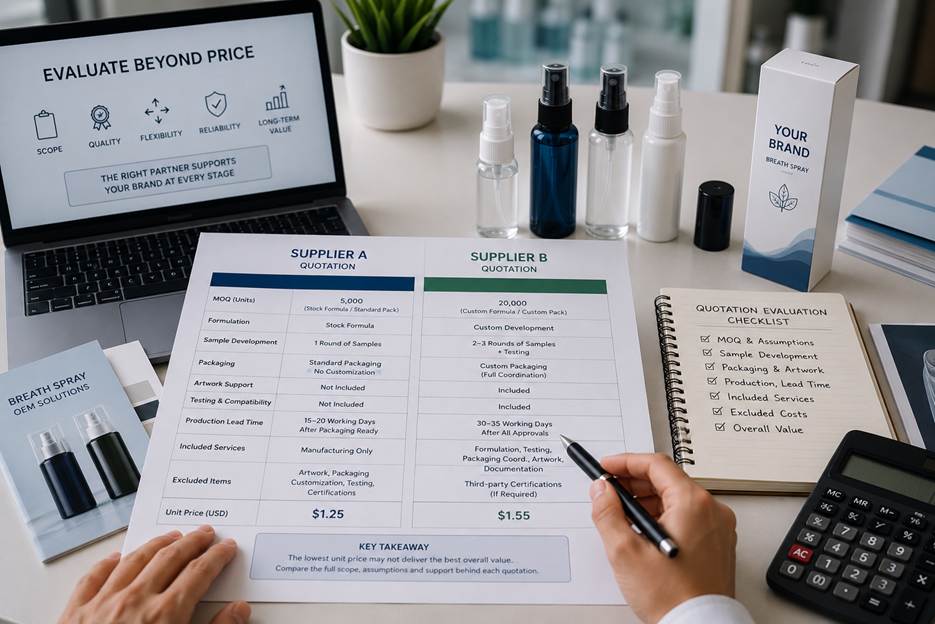
A breath spray project is not ready for commercial production once the formulation and packaging have been approved. Manufacturers should also be able to coordinate the activities needed to prepare the product for production and distribution.
Evaluating this capability helps buyers understand whether an OEM partner can manage the transition from product development to commercial manufacturing while clearly defining the documentation and responsibilities associated with the project.
These activities often involve multiple suppliers and production schedules. Artwork approval, packaging decoration, carton specifications, and export preparation should be coordinated alongside manufacturing to help avoid unnecessary delays or last-minute changes.
A capable private label oral spray supplier should be able to coordinate these activities as part of the overall manufacturing process while clearly defining the responsibilities of both parties. Establishing these expectations early helps buyers prepare for production and export without creating unnecessary assumptions about regulatory or documentation support.
A quotation should be evaluated according to the complete manufacturing scope, not the unit price alone. Differences in MOQ, packaging, sample development, production planning, and lead-time assumptions can significantly affect the overall value of an OEM partnership. Understanding exactly what is included helps buyers compare manufacturers on a like-for-like basis.
For example, one supplier may offer a lower MOQ by using a stock formulation and standard packaging with limited customization. Another may recommend a standard commercial MOQ that includes formulation development, packaging coordination, compatibility testing, and a production process tailored to the project.
While the second option may require a larger initial commitment, it may also provide a clearer project scope, better coordination between the formulation and packaging system, fewer late-stage technical changes, and more predictable production planning.
When reviewing quotations from different manufacturers, consider whether they clearly explain:
Understanding what is excluded from a quotation is just as important as understanding what is included. Differences in project scope often explain why pricing varies between manufacturers.
Instead of comparing quotations based on cost alone, evaluate how each proposal supports the overall success of your breath spray manufacturer evaluation. If you’d like to learn more about commercial planning and production timelines, our dedicated guide covers these topics in greater detail.
A manufacturer evaluation should identify potential risks as well as technical strengths. Many production issues can be traced back to gaps that were already visible during product development, quotation discussions, or sample planning.
The following issues may indicate weaknesses in technical capability, project planning, or manufacturing coordination:
These warning signs do not necessarily mean a manufacturer is unsuitable, but they should encourage further discussion before moving forward.
A capable OEM breath spray manufacturer should be able to explain its development process, define the project scope clearly, and demonstrate how formulation, packaging, and production planning are coordinated throughout the project.
Positive evaluation signals are equally important. An experienced manufacturer will usually ask detailed questions before confirming pricing, lead times, or production recommendations. These discussions often cover the intended formulation direction, flavour profile, fill size, pump platform, target market, packaging requirements, product claims, and expected production volume.
Experienced manufacturers also tend to delay confirming quotations or production schedules until the essential project requirements have been clearly defined. This is usually a sign of careful project evaluation rather than slow decision-making.
Rather than delaying the project, these technical questions help the manufacturer assess feasibility, identify potential risks early, and recommend a manufacturing approach that is appropriate for the project’s requirements
Discussions with a manufacturer often reveal more than brochures or quotations. Asking project-specific questions helps buyers understand how an OEM partner approaches formulation development, packaging compatibility, pump selection, low-fill production, and commercial planning.
These conversations also make it easier to compare manufacturers based on technical capability rather than price alone.
These questions provide a practical framework for how to evaluate a private label breath spray manufacturer beyond pricing or certifications. They help buyers compare OEM partners based on their ability to coordinate formulation, packaging, low-fill production, and commercial preparation as one integrated manufacturing system.
Choosing a breath spray manufacturer means evaluating more than individual production capabilities. Formulation development, packaging integration, pump selection, low-fill manufacturing, sampling, and commercial coordination all contribute to the success of the finished product.
Assessing these capabilities together provides a clearer picture of whether an OEM partner can successfully deliver your project.
At ORALABX, we help brands evaluate key manufacturing considerations before commercial production begins. Our team reviews the proposed formulation direction, packaging platform, pump compatibility, sample revisions, and overall production scope to assess the technical and commercial feasibility of each project before manufacturing proceeds.
Whether you’re developing a new private label breath spray or refining an existing concept, submit your project requirements for an initial feasibility review. We’ll work with you to evaluate the manufacturing approach and identify the most suitable development pathway before production begins.

Share your product type, target market, estimated volume and launch timeline. We will review the project scope and recommend the appropriate development path.
Best suited to brands, importers and distributors planning scalable commercial production.