Breath Spray

20 min read
July 31, 2026
Breath Spray
20 min read
July 31, 2026
In This Article
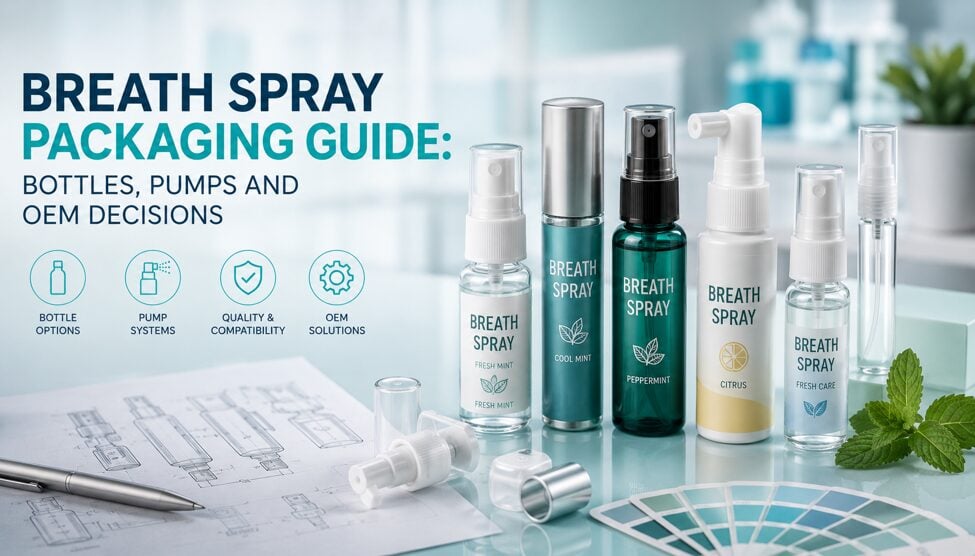
In a private label breath spray project, breath spray packaging is more than the product’s outer appearance. The packaging system influences manufacturing feasibility, product performance, user experience, and production planning, making it one of the most important decisions in the development process.
Manufacturers evaluate packaging long before artwork is approved or commercial production begins. Selecting the right packaging system helps support reliable filling, consistent product performance, and efficient manufacturing while reducing the need for unnecessary changes later in development.
This guide explains how manufacturers evaluate breath spray packaging before sampling and production. Readers looking for a broader overview of the development process can also explore our guide to launching a private label breath spray brand.
A breath spray package is made up of several components that work together to deliver the finished product. The bottle, pump, actuator, closure, and formula function as one integrated packaging system because each component influences how the others perform.
An attractive bottle does not automatically provide reliable filling performance or consistent spray delivery. Likewise, a well-designed pump must be compatible with both the bottle and the formulation to perform as intended. Looking at the packaging system as a whole allows manufacturers to identify compatibility issues before sampling and commercial production.
Every packaging component contributes to how the product performs during manufacturing and everyday use. Confirming that they work together supports:
Changing the bottle or pump after the packaging platform has been confirmed can affect more than the product’s appearance. It may require another compatibility review, artwork revision, and production validation before manufacturing can move forward.
In most projects, manufacturers first confirm the packaging platform, complete the necessary compatibility assessments and sample review, and then finalize packaging dimensions and artwork. While the exact development sequence varies from project to project, technical packaging decisions should be established before artwork is finalized to help reduce unnecessary revisions later in development.
Planning breath spray packaging and oral spray packaging as one coordinated system helps reduce these disruptions and supports a smoother production process.
Every breath spray product has its own packaging requirements, so manufacturers select the bottle and pump according to how the finished product is expected to perform. Factors such as the intended use, dispensing pattern, fill volume, and user experience all influence which packaging combination is the most suitable for the project.
The bottle and pump are selected together because each component affects the other. Bottle size influences portability and filling performance, while the pump controls spray output and dispensing characteristics.
When these components are compatible, they contribute to consistent production, reliable product performance, and a better user experience.
One of the early packaging decisions is whether to use a stock packaging platform or develop a custom solution. The right option depends on the project’s commercial goals, development timeline, and branding requirements.
An experienced breath spray manufacturer should be able to assess available bottle and pump platforms, coordinate qualified packaging component suppliers, and confirm that the selected components are suitable for the finished-product project.
By considering bottle design, pump performance, and spray output together, manufacturers can develop a packaging system that supports both the product concept and reliable commercial manufacturing.
Terms such as spray, mist, and mouth spray are often used interchangeably, which can make packaging discussions confusing for first-time buyers.
From a manufacturing perspective, these names do not determine how the product is packaged. Instead, manufacturers evaluate how the finished product is expected to dispense and perform so they can recommend a suitable bottle and pump combination for the project.
Manufacturers select the dispensing system according to the product’s performance requirements. Factors such as output per actuation, spray pattern, pump compatibility, formula composition, flavour intensity, intended use, and fill volume all influence which packaging configuration is the best fit.
Compatibility with the formulation, including viscosity where relevant, is also reviewed to help ensure the selected packaging performs as intended. Looking at these factors together allows manufacturers to recommend a packaging system that supports both the desired user experience and reliable commercial production.
Choosing a dispensing system involves balancing several product requirements, including:
Packaging decisions are guided by product performance, not by the commercial name printed on the label. Buyers looking for a deeper explanation of flavour release, volatility, and sensory performance can explore ourBreath Spray Science guide.
The right fill size depends on more than how much product fits inside the bottle. Manufacturers consider how the breath spray will be used, how often it is expected to be carried, and the type of experience the brand wants to deliver. These factors help determine a packaging format that is practical for both everyday use and commercial production.
A smaller bottle may be easier to carry in a pocket or handbag, while a larger fill size may offer more applications before replacement. The intended usage pattern also influences the packaging dimensions, bottle selection, and overall product presentation.
Looking at these requirements together allows manufacturers to recommend a packaging solution that fits the product concept without creating unnecessary production challenges.
Selecting a fill size involves balancing several practical considerations, including:
Every packaging decision involves trade-offs. A compact bottle may improve portability, while a larger container can provide more product per unit. The most suitable option depends on how the product is positioned and the experience the brand wants to create.
These considerations help manufacturers develop custom breath spray packaging and select a breath spray bottle that supports both user convenience and commercial production.
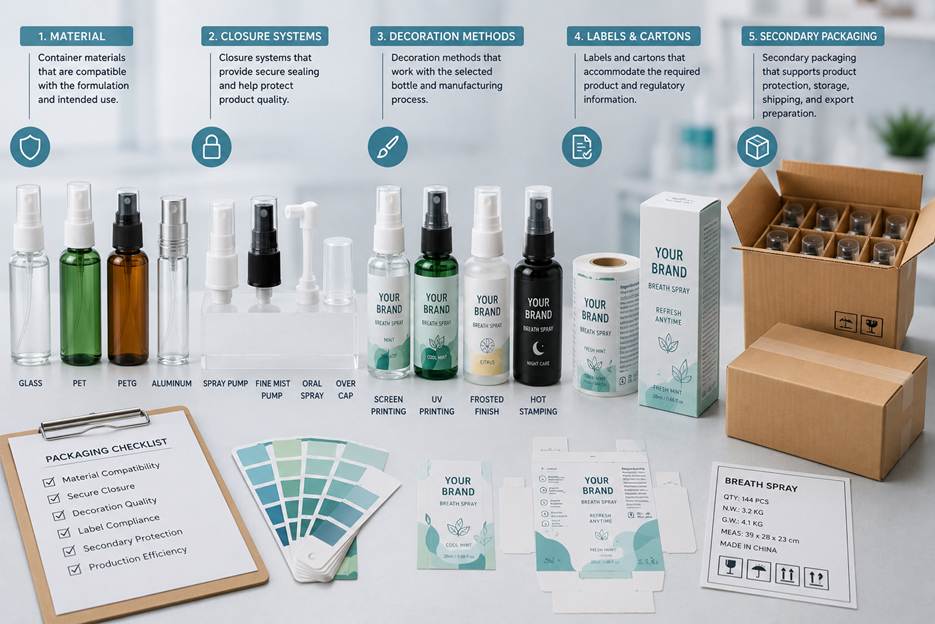
Once the primary packaging system has been established, manufacturers confirm the remaining packaging components that protect the product and prepare it for commercial distribution.
This includes selecting suitable container materials, closure systems, decoration methods, labels, cartons, and secondary packaging that are compatible with both the product and the manufacturing process.
Each packaging component has a practical purpose beyond presentation. The choice of material can influence product protection and compatibility, while the closure system helps maintain product integrity throughout storage and transportation.
Decoration methods, labels, and cartons also need to work with the selected packaging platform and production process to avoid unnecessary manufacturing complications.
To create a packaging system that performs reliably throughout production and distribution, manufacturers typically confirm:
When these packaging elements are planned alongside the primary packaging system, manufacturers can reduce production challenges and prepare a finished product that is ready for commercial distribution without compromising manufacturing efficiency.
Choosing a suitable bottle and pump is only part of the packaging development process. Before commercial production begins, manufacturers confirm that the formulation and packaging system work together under expected production and initial use conditions.
This compatibility review helps identify practical issues early, allowing adjustments to be made before they become more costly manufacturing problems.
Prototype samples provide an opportunity to evaluate how the selected packaging performs with the finished formulation. Testing at this stage helps manufacturers identify immediate issues while the project is still in development, reducing the likelihood of unnecessary changes after artwork has been approved or production has started.
Depending on the formulation, packaging system, and destination market, additional longer-term stability, transport, ageing, or compatibility evaluation may still be required before commercial launch.
Early compatibility testing focuses on the initial performance of the complete packaging system. Manufacturers typically review:
While these evaluations provide valuable information during product development, they do not by themselves establish long-term product stability or packaging performance throughout the product’s shelf life. Additional validation may be appropriate depending on the formulation, packaging configuration, and market requirements.
Confirming oral spray pump compatibility before production helps reduce manufacturing risk and gives brands greater confidence that the selected breath spray pump and packaging system are suitable to move forward in the development process.
Packaging decisions influence more than the finished product. They also affect how a project is planned and manufactured. The packaging platform, sourcing approach, decoration method, and component availability all play a role in determining project complexity, production timelines, and commercial planning.
For example, a stock bottle with standard decoration may allow manufacturers to use established component sourcing routes with relatively straightforward sampling and validation. Choosing a custom-colour bottle or a specialized pump may introduce additional component requirements, sampling, compatibility review, and sourcing time.
A fully custom tooled bottle generally involves the greatest level of development, often requiring tooling, higher component MOQs, longer sourcing timelines, additional validation, and more extensive artwork coordination before commercial production can begin.
The packaging platform selected for a project can influence several commercial factors, including:
Stock packaging platforms can help reduce sourcing complexity and may shorten validation time, while custom bottles or pumps can strengthen product differentiation but often require additional tooling, higher component MOQs, longer lead times, more artwork coordination, and additional compatibility work before production begins.
Brands exploring different private label breath spray packaging options should consider these commercial implications alongside their product goals. Understanding these relationships makes it easier to choose breath spray packaging that supports both the desired brand identity and an efficient manufacturing process.
In practice, changing packaging after tooling or artwork approval usually has a much greater commercial impact than making the same decision during the early concept stage.
Artwork approval should be one of the final technical decisions in a breath spray project, not one of the first design activities. Although packaging design often receives early attention, manufacturers recommend finalizing artwork only after the packaging system has been technically confirmed.
Making changes to the bottle, pump, or packaging specifications after artwork has been approved can lead to additional revisions, production delays, and unnecessary costs.
Before artwork is finalized, manufacturers verify that the packaging platform, formulation, and production requirements are aligned. This review helps confirm that the selected packaging system is suitable for commercial manufacturing and that the necessary technical packaging specifications have been established before labels, cartons, and other printed materials move into production.
Manufacturers typically recommend confirming the following before approving artwork:
The manufacturer may review artwork to confirm production feasibility, such as print layout, packaging dimensions, and compatibility with the approved packaging system. However, this review is separate from final destination-market compliance or regulatory approval, which remains the responsibility of the brand or its appointed responsible regulatory party.
Approving artwork after these technical checks helps avoid unnecessary revisions if packaging specifications change later in development.
A successful breath spray depends on more than attractive packaging. The formulation, packaging system, and manufacturing process need to work together to support reliable product performance and efficient commercial production.
At ORALABX, we coordinate formulation development, packaging sourcing, prototype review, filling, and finished-product manufacturing to help brands develop breath spray products that are practical for commercial production.
Throughout the development process, formulation and packaging decisions are reviewed together to confirm suitability for the project and reduce compatibility risks before commercial manufacturing begins.
Learn more about our Breath Spray Manufacturing Services or contact the ORALABX team to discuss your project.

Share your product type, target market, estimated volume and launch timeline. We will review the project scope and recommend the appropriate development path.
Best suited to brands, importers and distributors planning scalable commercial production.