In This Article
Mouthwash can be formulated for many goals: fresh breath, plaque control, cavity protection, sensitivity support, whitening, gum-care positioning, or gentle daily hygiene. The active ingredient in mouthwash depends on the product’s intended function and the regulatory rules of the target market. This guide introduces common mouthwash active ingredients, their primary functions, and the product categories in which they are commonly used.
The active ingredient in mouthwash is the ingredient that provides the product’s primary oral care benefit. Depending on the formulation, it may support cavity protection, antibacterial action, fresh breath, whitening, or other oral hygiene functions.
Different mouthwash products use different active ingredients because each ingredient performs a different role. For example, fluoride is commonly used for cavity protection, while cetylpyridinium chloride (CPC), essential oil systems, and chlorhexidine are associated with antibacterial mouthwash formulations. Zinc salts are widely used for odor control, peroxide systems are found in whitening mouthwash, and xylitol is commonly included in sugar-free daily oral care products.
The table below summarizes several common active ingredients used in mouthwash and their primary functions.
| Active Ingredient | Primary Function | Typical Products |
| Fluoride | Cavity protection and enamel support | Cavity-protection mouthwash, enamel-care rinse |
| Cetylpyridinium Chloride (CPC) | Antibacterial support and plaque control | Antibacterial mouthwash, daily plaque-control rinse |
| Essential Oil Systems | Antibacterial support and fresh breath | Essential oil mouthwash, herbal mouthwash |
| Chlorhexidine | Short-term antimicrobial care | Professional mouthwash, prescribed oral rinse |
| Zinc Salts | Odor control | Fresh breath mouthwash, daily breath rinse |
| Hydrogen Peroxide | Whitening support | Whitening mouthwash, stain-removal rinse |
| Xylitol | Supportive daily oral care | Sugar-free mouthwash, family oral care rinse |
Fluoride
Fluoride is one of the most widely used active ingredients in mouthwash and is commonly included in oral care formulations designed for cavity protection and enamel support. It helps strengthen tooth enamel and is widely used in fluoride in oral care, toothpaste formulation, and other daily oral hygiene products. Fluoride is commonly found in cavity-protection mouthwash, enamel-care rinses, and other products formulated for long-term oral hygiene. The permitted fluoride concentration, product claims, and regulatory classification may differ between countries. Permitted fluoride concentrations, product claims, and regulatory classifications vary between countries.
Cetylpyridinium Chloride (CPC)
Cetylpyridinium chloride (CPC) is a quaternary ammonium compound commonly used as an active ingredient in mouthwash for antibacterial support and plaque control. It is included in many daily oral care products designed to reduce oral bacteria while supporting fresh breath and gum hygiene. CPC is commonly found in antibacterial mouthwash, plaque-control rinses, and alcohol-free oral hygiene formulations. CPC may interact with certain formulation ingredients. A cosmetic mouthwash manufacturing scope should evaluate compatibility before production.
Essential Oil Systems
Essential oil systems are another common active ingredient in mouthwash, particularly in formulations designed for antibacterial support and fresh breath. Ingredients such as menthol, thymol, eucalyptol, and methyl salicylate are frequently used in oral hygiene products to provide antimicrobial activity together with a characteristic refreshing sensation. These systems are commonly found in essential oil mouthwash, herbal mouthwash, and alcohol-free daily rinses. Essential oils require suitable solubilization systems to remain evenly dispersed in water-based formulations, and allergen declaration requirements may apply in some markets.
Chlorhexidine
Chlorhexidine is a specialized active ingredient in mouthwash used for short-term antimicrobial care in professional oral health settings. Unlike ingredients intended for everyday use, chlorhexidine is generally included in professional mouthwash and prescribed oral rinse products for temporary oral care support. It is less common in standard consumer mouthwash formulations. Chlorhexidine products generally include specific directions for short-term use, and product labeling varies according to local regulatory requirements.
Zinc Salts
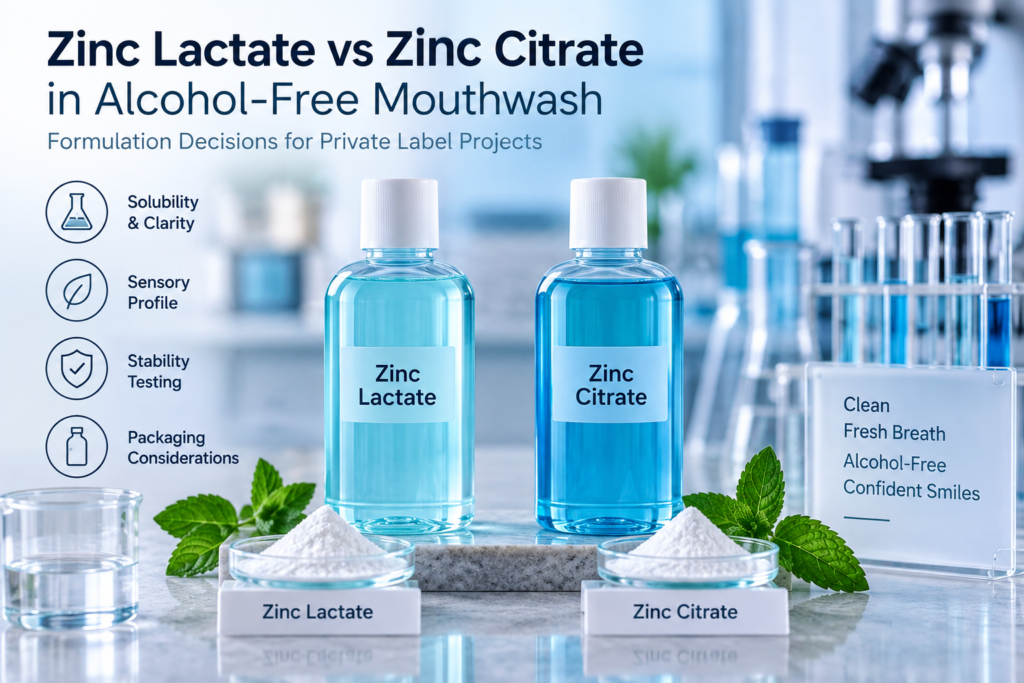
Zinc salts are widely used as an active ingredient in mouthwash for odor control and fresh breath management. Instead of primarily targeting bacteria, zinc helps reduce volatile sulfur compounds that contribute to unpleasant breath. Zinc is commonly included in fresh-breath mouthwash, alcohol-free rinses, and daily oral hygiene products designed for long-lasting breath freshness. Flavor optimization is often important because different zinc compounds may influence the sensory profile of the finished product.
Hydrogen Peroxide
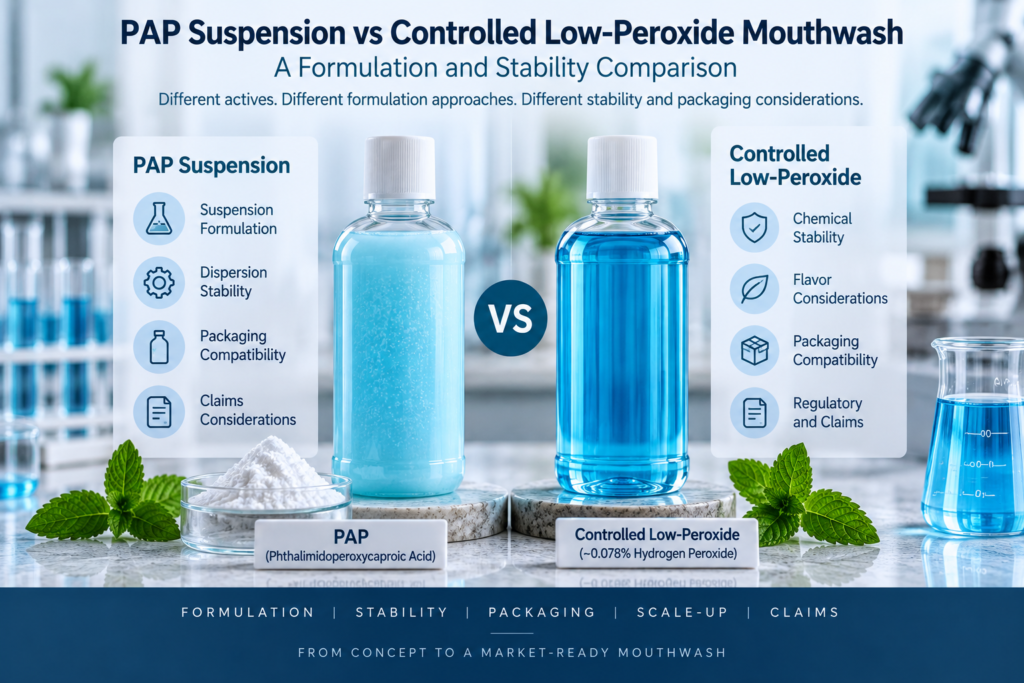
Hydrogen peroxide is a common active ingredient in mouthwash used in whitening formulations designed to support stain removal and cosmetic tooth whitening. It is frequently included in whitening mouthwash and stain-removal rinses as part of broader oral care product lines. Its concentration and permitted use vary according to local regulations. Hydrogen peroxide is sensitive to light, heat, and air exposure, so packaging compatibility and formulation stability are important considerations. A whitening mouthwash private label project should confirm these limits early.
Xylitol
Xylitol is a supportive active ingredient in mouthwash that is frequently included in sugar-free oral care products and daily mouthwash formulations. Although it is not usually the primary functional ingredient, it contributes to a pleasant taste profile while supporting sugar-free positioning in oral hygiene products. Xylitol is commonly found in family mouthwash, daily rinses, and children’s oral care products. Xylitol is often combined with other active ingredients because it functions as a supportive component rather than the primary active ingredient in most mouthwash formulations.
In mouthwash formulation, the active ingredient is the component responsible for delivering the primary functional benefit. This includes claims such as cavity protection, odor control, whitening support, or antibacterial action. It is the key driver behind how the product is positioned in the market and how its effectiveness is communicated to consumers.
In contrast, the mouthwash base refers to the complete formulation system that carries the active ingredient and enables it to function properly in real-world use. While the active defines what the product is meant to do, the base determines how well it performs during actual use. A typical mouthwash base consists of a water phase combined with solubilizers, humectants, sweeteners, and flavor systems, along with preservatives, pH adjusters, optional colorants, and other supporting ingredients. The formulation may also be designed as either alcohol-free or alcohol-containing, depending on the product concept.
Both CPC and essential oil systems are widely used in antibacterial mouthwash formulations, but they differ in composition, mechanism, formulation characteristics, and common applications.
| Feature | CPC | Essential Oil Systems |
| Ingredient type | Synthetic quaternary ammonium compound | Blend of plant-derived aromatic compounds |
| Primary function | Antibacterial support and plaque control | Antibacterial support and fresh breath |
| Typical ingredients | Cetylpyridinium chloride | Menthol, thymol, eucalyptol, methyl salicylate |
| Common applications | Daily antibacterial mouthwash, plaque-control rinse | Herbal mouthwash, fresh-breath rinse, botanical oral care |
| Formulation considerations | Requires compatibility with certain ingredients and pH | Requires effective solubilization and stability systems |
| Regulatory considerations | Product claims vary by market | Ingredient labeling and allergen requirements may vary by market |
Although both ingredient systems are used in antibacterial mouthwash, they represent different formulation approaches. CPC is a single antibacterial compound, while essential oil systems consist of multiple naturally derived aromatic ingredients combined within one formulation.
An alcohol free mouthwash manufacturer can help brands evaluate daily care bases, sensitive-mouth positioning, and alcohol-free formulation requirements before development begins.
| Mouthwash Base Type | Common Users | Possible Ingredients / Systems |
| Alcohol-free daily care base | sensitive-mouth positioning; family-friendly daily rinse; microbiome-friendly concepts | Alcohol-free base; mild flavor systems; humectants; preservatives |
| Antibacterial / plaque-control base | Breath control; plaque support; gum-care positioning; pharmacy or professional channels | CPC; essential oil systems; other compliant antimicrobials |
| Odor-neutralizing base | Fresh breath products; microbiome-friendly breath management; gentle daily rinse | Zinc salts; flavor systems; pH-supporting ingredients |
| Whitening mouthwash base | Beauty oral care; whitening product lines; retail and DTC sets | Peroxide systems (where permitted); stain-removal ingredients; clarity-enhancing systems |
| Enamel-care / remineralization base | Enamel care; cavity protection; fluoride or fluoride-free mineral concepts | Fluoride systems (where allowed); mineral-support ingredients; buffering systems |
| Natural / botanical base | Natural brands; herbal positioning; | Botanical extracts; mild essential oils; alcohol-free carriers; vegan systems |
For brands developing private label mouthwash with different active ingredient strategies, ORALABX provides modern clean-label private label mouthwash bases for global oral care markets. Its formulation options cover alcohol-free, antibacterial, odor-control, whitening, sensitive-care, enamel-care, and natural mouthwash directions, supported by COA, SDS, QC sheets, stability testing, microbiological testing including challenge testing, pH and clarity analysis, third-party testing protocols, and batch-by-batch quality control. These base systems can serve as practical starting points for different product concepts: an odor-control rinse may use a zinc-compatible alcohol-free base, a sensitive daily rinse may focus on low-burn flavor design and gentle preservation, while a whitening rinse may require stronger stability and packaging compatibility. Formulation and production details are confirmed based on each project’s requirements.
There is no single active ingredient for all mouthwash products. Fluoride is common for cavity protection, CPC and essential oil systems are used for antibacterial or plaque-control positioning, zinc salts are often used for odor control, and peroxide-based systems may be used for whitening where permitted.
Alcohol is usually not the main active ingredient. It may act as a solvent or sensory component in some formulas, but many modern mouthwash products are alcohol-free for a gentler daily-use experience.
Fresh breath products may use zinc salts, CPC, essential oil systems, flavor technologies, or other odor-control strategies. The choice depends on whether the brand wants a gentle daily rinse, antibacterial positioning, or stronger breath-management claims.
Some whitening mouthwash formulas use peroxide-based systems where permitted. Others focus on stain-management support and cosmetic brightening positioning. Whitening claims should be substantiated and market-compliant.
Brands should consider target claims, regulatory classification, pH, stability, taste, packaging compatibility, testing requirements, and consumer positioning.
Yes. Experienced manufacturers can develop custom bases for alcohol-free, odor-control, whitening, sensitive-care, enamel-care, or clean-label positioning. The results come from aligning the active ingredient and formula base early in development.
No. Regulatory requirements differ between markets, and permitted ingredient concentrations, product claims, labeling requirements, and product classifications may vary. Mouthwash formulations are typically developed according to the regulations of the target market.
The active ingredient in mouthwash determines the product’s primary oral care function and can generally be grouped into five categories: cavity protection, antibacterial support, odor control, whitening, and supportive daily oral care. Fluoride, CPC, essential oil systems, chlorhexidine, zinc salts, hydrogen peroxide, and xylitol each serve different roles within these functional categories.
Understanding these ingredient groups provides a clearer picture of how mouthwash formulations are designed. Although formulations may vary by product type and regulatory market, the functional category of the active ingredient remains one of the most important ways to classify mouthwash products.
Different active ingredients may require different formulation systems, packaging compatibility, stability evaluation, and regulatory documentation. During product development, manufacturers generally formulate mouthwash according to the selected active ingredient, intended product function, and the regulatory requirements of the target market, while manufacturing specifications and commercial arrangements vary by project.
Share your product type, target market, estimated volume and launch timeline. We will review the project scope and recommend the appropriate development path.
Best suited to brands, importers and distributors planning scalable commercial production.