In This Article
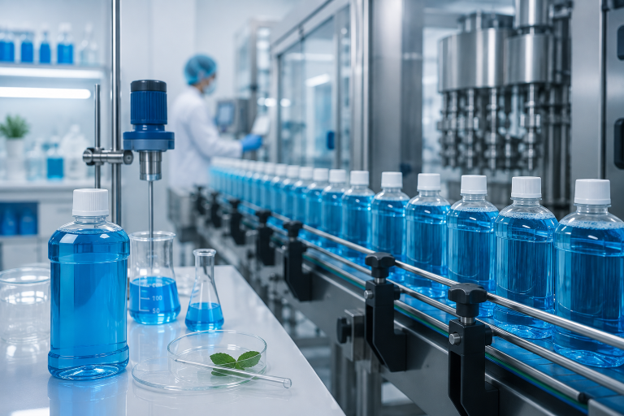
Once a mouthwash formula has been approved, the next step is turning that formula into a consistent commercial batch. From preparing the materials to mixing, filling, sealing, and releasing the finished product, each stage has a defined place in the production process.
For brands working with an OEM mouthwash manufacturer, understanding this process makes it easier to see how a batch moves through production and where quality is checked along the way.
This guide follows the production batch from the production order and raw-material weighing through compounding, filling, quality checks, finished-product release, and shipment.
Once the formula is approved, commercial mouthwash production moves through a defined sequence from production preparation to shipment. Quality checks and operational confirmations occur at relevant points as the batch, product, packaging, and records move through production.
| Process Stage | What Happens | What Is Checked / Confirmed |
| 1. Production Order & Approved Formula Release | The production instruction is issued, and the approved formula, raw-material lots, and packaging version are confirmed. | Confirm alignment between the production instruction, the approved formula/version, the materials to be used, and the applicable packaging records. |
| 2. Raw-Material Weighing | Materials are drawn against the production instruction, weighed, and cross-checked for identity and lot. | Weighing is verified against the approved formula and material lots are recorded. |
| 3. Compounding & Mixing | Purified water and each material are added in the defined formula sequence, with flavour added according to the process where applicable. | Production personnel confirm, through applicable in-process checks, that materials and sequence follow the approved formula. |
| 4. Bulk Adjustment & Final Mixing | The batch is mixed to uniformity, with applicable product characteristics adjusted or confirmed according to the approved process. | Appearance and uniformity are checked. |
| 5. Bulk In-Process QC | A sample of the semi-finished bulk is checked against the approved specification. | Applicable checks may include appearance, odour, pH, and density. |
| 6. Transfer / Filtration / Holding | The bulk is transferred to the appropriate holding system. Filtration is used where required by the approved process. | Transfer and holding are confirmed operationally, including clarity where filtration applies. |
| 7. Bulk Confirmation Before Filling | The bulk is confirmed against the applicable requirements before filling proceeds. | The bulk is confirmed against the approved process and applicable requirements. |
| 8. Filling | The bulk is filled into bottles at the set volume. | Fill-volume or net-content check. |
| 9. Capping / Sealing | Caps are applied, along with applicable inner foil, shrink band, or other sealing structure. | Cap/seal integrity and leakage are checked. |
| 10. Coding / Labelling | LOT/EXP and other required information are coded, followed by labels, sleeves, or other decoration. | Code legibility, label correctness and position, and missing or misapplied labels are checked. |
| 11. In-Line Quality Checks | Quality checks are performed at applicable points during filling, sealing, coding, and labelling. | Applicable checks include fill volume, cap/seal, leakage, label position/print, and batch code. |
| 12. Secondary Packing | Products are boxed or packed into applicable combination packs or shrink packaging, then placed into inner and outer cartons. | Packing, carton markings, and quantities are checked and reconciled. |
| 13. Finished-Product QC & Release | The finished product is sampled and assessed against the approved specification. | Applicable sensory, physicochemical, microbiological, net-content, and packaging/seal/carton checks inform the batch disposition decision (e.g., Qualified, Rework, or Concession, per the applicable factory’s quality process). |
| 14. Warehousing | Released goods are stored by batch, with batch records retained and released goods segregated. | Batch identity and release status are maintained in the records and storage arrangement. |
| 15. Shipment Release & Container Loading | Contract, SKU, LOT, and carton counts are reconciled, shipping documents are prepared, and the container is loaded. | Shipping documents, including the finished COA, are verified against the order before loading. |
Commercial production begins with the production order and the release of the approved formula for manufacturing. Before the batch starts, the production instruction is aligned with the approved formula or version, the materials to be used, and the applicable packaging records. This typically includes confirming:
This alignment helps ensure that the batch is produced using the correct approved formula, materials, and packaging rather than information from an earlier or different production version.
Once the production order and approved formula have been released, the required raw materials are drawn and weighed according to the production instruction. Each material needs to correspond with the one specified for the batch.
Before the materials move into production, the records are cross-checked for:
These checks establish a record of which materials and lots went into the mouthwash batch before compounding begins.
With the materials weighed and verified, production moves into compounding and mixing. The purified water and raw materials are introduced according to the defined production sequence, with flavour added where applicable.
At this stage, the focus is on following the approved process rather than changing the formula during production. Production personnel verify, through applicable in-process checks, that:
These checks help keep the bulk aligned with the approved formula as it moves toward the next production stage.
After the initial compounding, the bulk is mixed until it reaches the required uniformity. Where applicable, product characteristics are adjusted or confirmed according to the approved production process.
At this stage, the production team checks the bulk for appearance and uniformity before it moves to the next step. These observations help confirm that the batch remains consistent with the applicable production requirements.
Before the bulk moves toward filling, a sample is checked against the applicable product specification. This provides a way to confirm that the semi-finished mouthwash is still within the requirements established for the product.
Depending on the approved specification, the checks may include:
The acceptance criteria are product-specific, so the results should be assessed against the approved specification rather than a generic range.
Once the bulk has been checked, it moves into the appropriate holding system before filling. Where filtration is part of the approved process, the bulk is filtered during this transfer.
This stage is primarily an operational step covering the movement and condition of the bulk:
Once the transfer and holding are complete, the bulk moves to confirmation before filling.
Before filling begins, the bulk is confirmed against the applicable production and specification requirements. This confirms that the material being transferred to the filling line corresponds with the requirements for the approved batch.
The confirmation covers the requirements that apply to the product and production process, ahead of filling.
Once the bulk has been confirmed against the applicable requirements, it moves to the filling stage. The mouthwash is transferred into the designated bottles and filled to the set volume for the product, ahead of capping and sealing.
After filling, the bottles move through capping and sealing. Caps are applied to the filled bottles, followed by the applicable sealing structure, such as an inner foil, shrink band, or another approved seal, before the bottles move to coding and labelling.
Once the bottles are capped and sealed, the required product information is coded onto the packaging, followed by labelling or other applicable decoration. Rather than waiting until the finished products reach final QC, relevant checks continue while the line is running, including:
These in-line checks help identify issues while filling, sealing, coding, and labelling are still taking place, allowing affected products to be identified before secondary packing.
Once in-line checks are complete, products move into secondary packing. Depending on the product, this may include combination packs or shrink packaging, followed by placement into inner and outer cartons. Packing, carton markings, and quantities are checked and reconciled at this stage before the batch moves to finished-product QC.
Depending on the product and its approved specification, finished-product checks may include:
The results are then assessed through the applicable release process. Depending on the outcome, the batch is assigned a disposition under the manufacturer’s applicable quality process.
For example, terms such as Qualified, Rework, or Concession, though the specific terminology and criteria vary by factory. Acceptance criteria and release decisions remain specific to the approved product requirements.
Once the finished batch has been qualified, the released goods move into storage while the relevant batch records are retained. Released goods are kept identifiable by batch so that the products and their records remain connected through the shipment stage.
Before loading, the shipment details are reconciled against the order. This includes checking:
Once these checks are complete, the released goods can proceed to shipment.
Quality control in commercial mouthwash production is not limited to the final laboratory check. Checks are built into different points of the line so that materials, bulk product, packaging, and finished goods can be assessed as the batch moves through production.
Across the process, these checks include:
The result is a production process where quality checks and operational confirmations occur at multiple relevant points across the production flow, rather than being treated as a single final step.
Commercial mouthwash production begins with an approved formula and production order. The batch then moves through material weighing, compounding and mixing, bulk checks, filling, sealing, coding, labelling, packing, finished-product QC, and final release for shipment.
The mouthwash manufacturing process is the controlled sequence used to turn an approved formula into a finished commercial batch. It includes production preparation, raw-material handling, compounding, bulk and finished-product checks, filling, packaging, and release.
In an OEM factory, the approved formula and production instruction guide the batch. Materials are weighed and compounded in the defined sequence, the bulk is checked, and the finished mouthwash is filled, sealed, coded, labelled, packed, tested, and released according to the applicable requirements.
The applicable checks depend on the product specification. They may include appearance, odour, pH, density, microbiology, net content, fill volume, packaging and seal checks, coding, labelling, and leakage checks at different points in production.
An OEM mouthwash line moves the approved batch through defined production stages, with applicable quality checks at relevant points. Materials are prepared and mixed into bulk product, the bulk is checked before filling, bottles are filled and packaged, and the finished product and shipment documents are checked before release.
Commercial mouthwash production is more than mixing an approved formula and filling bottles. At ORALABX, the batch moves through defined production stages, with quality checks applied along the way, from raw-material verification and bulk inspection to filling, packaging, finished-product QC, and shipment release.
These checks help ensure that the product remains consistent with its approved requirements throughout production.
Quality checks at relevant points help verify that the batch remains aligned with the applicable product requirements as it moves through production, helping ORALABX deliver finished mouthwash that meets the applicable product and quality requirements.
If you’re ready to move your mouthwash product into commercial production, talk to the ORALABX team about your manufacturing requirements.

Share your product type, target market, estimated volume and launch timeline. We will review the project scope and recommend the appropriate development path.
Best suited to brands, importers and distributors planning scalable commercial production.