In This Article
A manufacturer cannot review an existing mouthwash from a product name and an ingredient list. Reformulation starts with the current specification, the reason for the change and the parts of the product that must not move.
“We need a new formula” is not a technical brief. State what changed. Alcohol may need to be removed. A preservative system may no longer fit the market. A raw material may be unavailable. The flavour may be too sharp. The cost may no longer work at the planned volume.
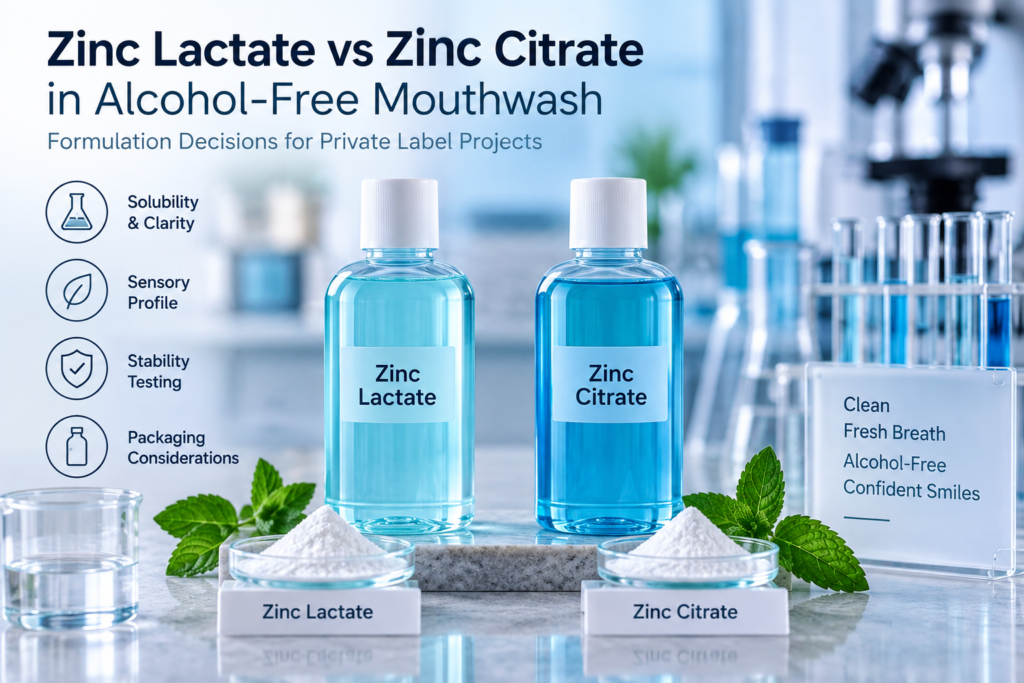
Each reason creates a different development path. Removing alcohol, for example, affects solubilisation, preservation, flavour delivery and mouthfeel at the same time. It is not a one-ingredient substitution.
The useful starting pack is short:
If the complete formula is confidential, an NDA can be signed before technical disclosure. A benchmark sample helps, but it does not replace the specification.
The manufacturer needs to know which points are mandatory. An active level, alcohol-free positioning, colour, flavour identity or “compare to” requirement may be fixed. Sweetness, cooling strength, bottle shape or secondary claims may still be adjustable.
When every feature is mandatory, there is no room to solve conflicts. When nothing is fixed, the review becomes open-ended concept work. Mark each item as fixed, preferred or open for recommendation.
For an existing product, “similar” is too vague. The review standard may include flavour onset, cooling curve, aftertaste, colour, clarity, foam, dose, cap behaviour and perceived freshness over time.
A manufacturer can compare against a retained sample or market benchmark. It should not be asked to copy an unknown formula. The objective is to rebuild an agreed performance profile within new technical, regulatory and cost limits.
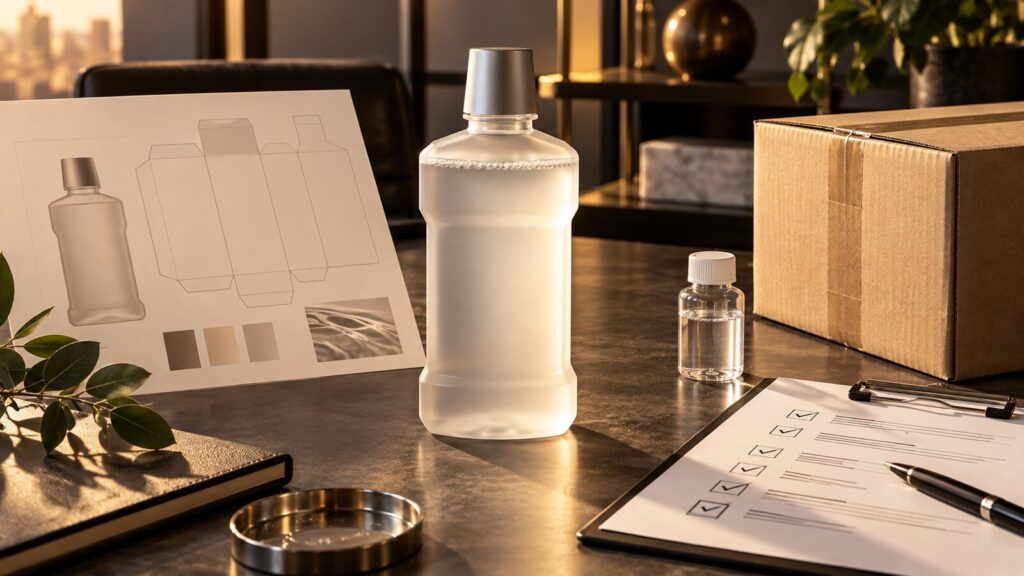
A formula that behaves in a laboratory bottle may change in the commercial pack. Pump output, liner contact, closure seal, evaporation, staining and transport temperature all matter. If the project changes the bottle, pump or single-dose format, compatibility work belongs in the reformulation plan from the beginning.
Testing depends on the formula, pack, claims and destination market. The programme may include stability, microbiological limits, preservative efficacy, packaging compatibility, leakage or project-specific third-party testing. Comparative claims must be defined before the protocol is agreed.
The manufacturer should state which documents already exist, which can be created for the project and which remain the brand’s or regulatory representative’s responsibility.
A review is ready when the company, target market, commercial volume, current product, change objective and decision criteria are known. If these inputs are missing, a quotation or sample will not answer the real question.
ORALABX evaluates cosmetic-pathway mouthwash projects from technical review through commercial manufacturing. U.S. OTC drug products remain outside our manufacturing scope.
Review ORALABX innovation capabilities or send a qualified project brief.
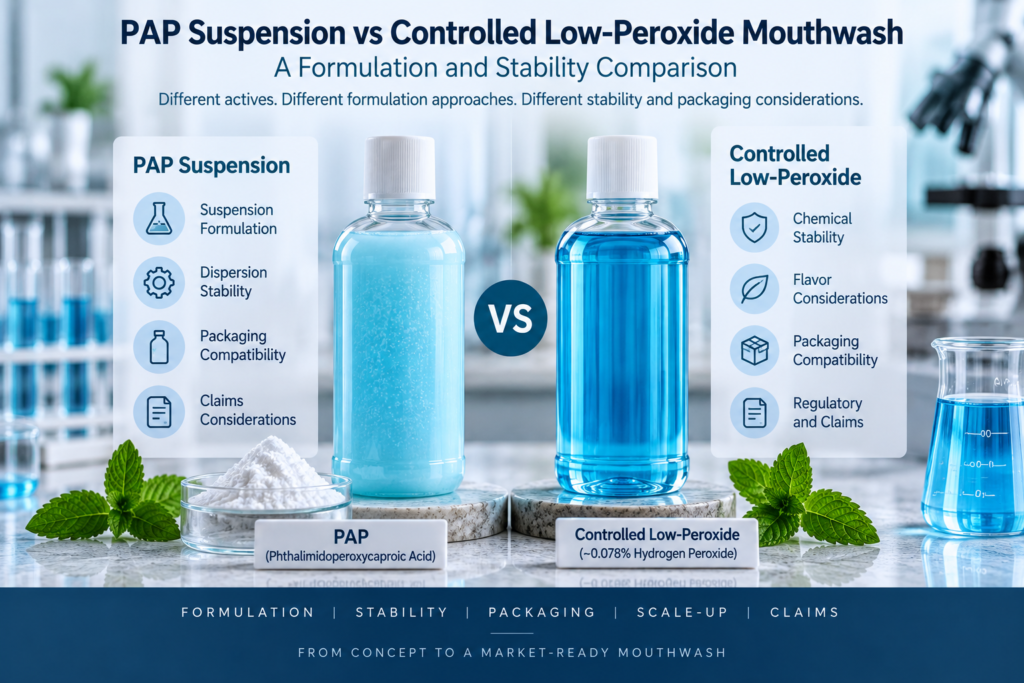
A commercially sensible reformulation does not always require rebuilding the complete formula. In one anonymized ORALABX development path, a mature low-concentration hydrogen peroxide mouthwash base was retained while the sensory direction was adjusted. The project could evaluate a flavor change or the removal of eucalyptus leaf oil without changing the overall formulation platform.
The technical review still needs to confirm the active level, pH target, flavor-solubilization approach, appearance, packaging components, and destination-market positioning. Removing or changing one aromatic component can influence taste balance and consumer perception even when the main system remains established.
This approach reduces unnecessary redevelopment while preserving the need for sample evaluation, compatibility review, and commercial approval. See the controlled low-peroxide formulation case study.
Where the revised brief prioritizes mild mouthfeel, the moisturizing mouthwash Development Brief provides a separate proposed formulation direction. Its scope and tests must be agreed for the actual project.

Share your product type, target market, estimated volume and launch timeline. We will review the project scope and recommend the appropriate development path.
Best suited to brands, importers and distributors planning scalable commercial production.