Breath Spray

17 min read
July 18, 2026
Breath Spray
17 min read
July 18, 2026
In This Article
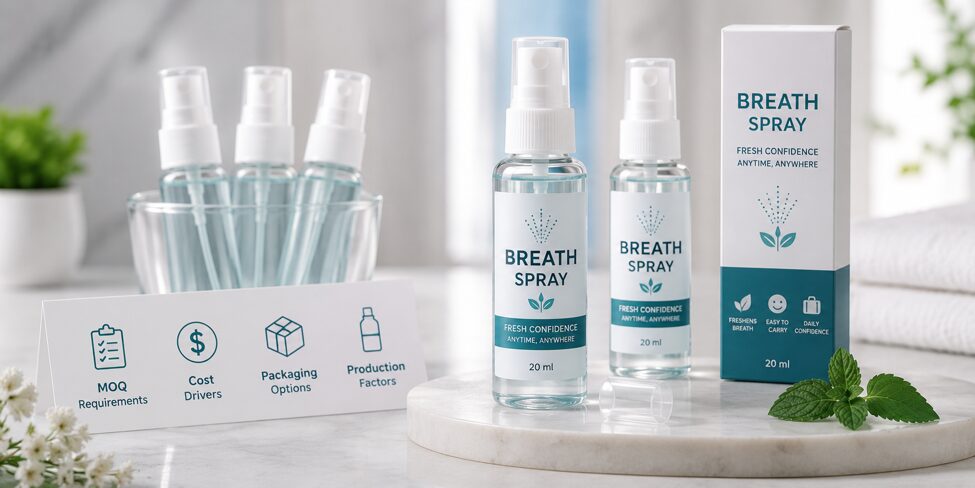
Requesting a quotation for a private label breath spray is often the first point where buyers discover that pricing involves much more than the liquid formula. From an OEM perspective, the bottle, pump system, packaging specifications, and production planning usually have a greater influence on project cost and minimum order quantity than the formula itself.
Understanding how these commercial factors work together makes it easier to interpret quotations, compare manufacturing proposals, and prepare the information an OEM manufacturer needs to provide accurate pricing.
This guide explains what determines breath spray MOQ and cost and how to plan your project before requesting a quotation.
A breath spray may contain only a small amount of liquid, but getting that liquid into a finished product involves much more than filling a bottle. Before production can begin, manufacturers need to confirm that the bottle, pump, overcap, decoration, and packaging components all work together as one commercial packaging system.
Each packaging decision creates another production decision. The bottle determines which pump can be used, the pump influences filling performance and spray delivery, decoration affects production setup, and every component has its own procurement and lead-time requirements. By the time those decisions come together, the packaging system has a much greater influence on commercial planning than the liquid inside the bottle.
This is why breath spray MOQ and cost are largely driven by packaging. Manufacturers are not pricing a bottle of liquid; they are planning how every packaging component will be sourced, assembled, filled, and moved through commercial production as efficiently as possible.
Understanding this relationship also makes quotations easier to compare. Two breath sprays may look almost identical on the shelf but use different packaging systems behind the scenes, leading to different sourcing requirements, production planning, and overall project costs.
Looking at the complete packaging system instead of the liquid formula gives buyers a much clearer basis for evaluating manufacturing proposals.
A breath spray manufacturer uses this complete packaging picture to assess feasibility and prepare quotations that reflect the actual commercial requirements of the project.
The minimum order quantity for breath spray is determined by what is needed to run the project efficiently at a commercial scale. Rather than being set by the amount of liquid in each bottle, MOQ reflects the point where packaging procurement, production planning, and manufacturing can come together in a practical and commercially viable way.
As a general planning reference, the minimum order quantity for breath spray is typically around 10,000 to 20,000 units. The final MOQ depends on the overall production plan and may vary from one project to another.
When establishing the final MOQ, manufacturers typically evaluate:
The final MOQ is determined by how these requirements fit together, not by any single supplier or production rule. For example, your bottle supplier may be able to support one production quantity, while the selected pump, decoration process, or production schedule may require a different commercial run. The manufacturer brings all of these requirements together before confirming the final MOQ.
Understanding what determines MOQ helps you plan your project more effectively and set realistic production expectations before requesting pricing.
If you are still planning your product, developing your private label breath spray launch first can help you define the specifications that ultimately influence commercial production.
The total cost of a breath spray project comes from much more than the liquid formula. When preparing a quotation, manufacturers assess every part of the finished product because each component contributes to the overall manufacturing cost.
The main cost drivers typically include:
Each of these affects the final quotation in a different way. For example, a more complex decoration process may require additional production steps, while a specialized formula may involve more development and validation before commercial production. Similarly, production planning influences how efficiently the project can move through manufacturing.
Among these cost drivers, the pump system often represents one of the largest contributors to unit cost. It does more than dispense the product. Pump quality influences spray consistency, filling performance, and overall manufacturing reliability, which is why it can account for a significant proportion of the finished product cost.
As a general planning reference, FOB pricing typically ranges from around USD 1.35 to 3.50 per unit, depending on the final product specification. Final pricing depends on factors such as the bottle format, pump system, level of customization, packaging requirements, and order quantity.
These figures are intended as an early budgeting guide rather than a fixed quotation, as every project is priced according to its specific manufacturing requirements.
Understanding where the cost comes from also makes it easier to evaluate quotations. Instead of comparing prices alone, compare the specifications behind those prices to see what is included in each proposal.
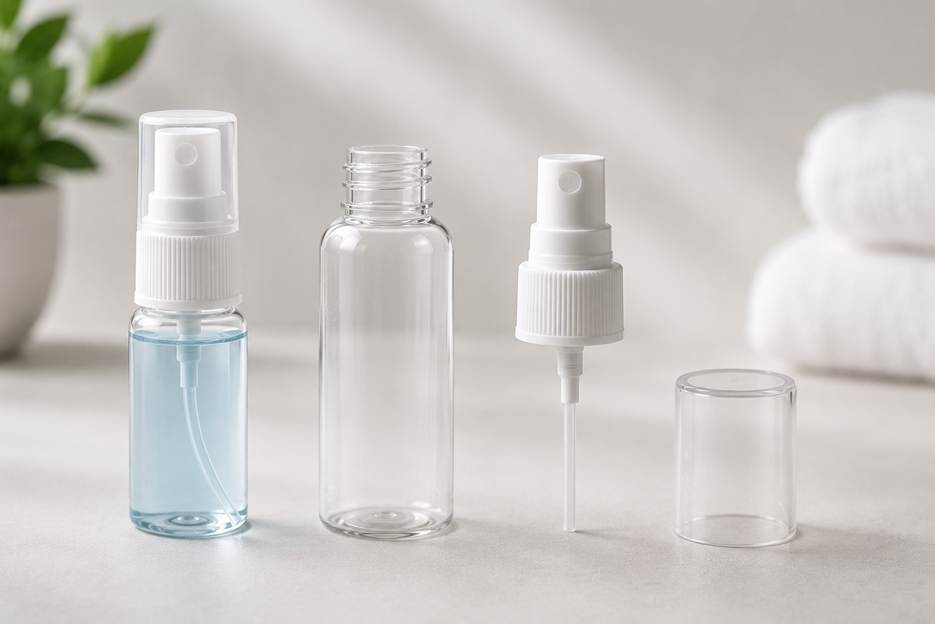
Bottle, pump, and decoration choices affect price because they determine how much work is required before the product is ready for commercial production. The quotation reflects more than the cost of the individual components. It also includes the work involved in sourcing, evaluating, and preparing the complete packaging system.
A good example is the difference between a stock formula and a custom formula. A stock formula is often paired with packaging that has already been evaluated as part of an existing manufacturing platform. Since the bottle, pump, and filling process are already established, there is usually less development work before production can begin.
A custom formula is different. New formulation requirements often mean the manufacturer needs to confirm that the selected bottle and pump remain compatible with the formula and perform as expected during production. If you also request a different bottle or pump, additional sourcing, compatibility reviews, and validation may be needed before the packaging system is ready for commercial manufacturing.
Decoration choices can have a similar effect on pricing. Standard decoration typically requires less preparation, while custom printing, specialty finishes, or unique artwork specifications may introduce additional setup, approvals, or production processes. These requirements become part of the overall manufacturing cost rather than simply the cost of the printed packaging.
This is why we would never give a final quotation until you finalize the entirety of the packaging system too. Stable packaging specifications allow the quotation to reflect the actual requirements of the project and reduce the likelihood of pricing changes as development moves forward.
Two breath sprays may look almost identical on the outside while requiring very different manufacturing resources behind the scenes. A similar bottle size or flavour does not necessarily mean two projects follow the same production pathway or should receive the same quotation.
When preparing a quotation, manufacturers look beyond the finished appearance of the product. They evaluate factors such as:
Each of these influences the overall manufacturing process. For example, two breath sprays may use bottles with the same capacity, but one project may include a premium pump, custom decoration, and a more specialized formulation. Although the finished products appear similar, the manufacturing resources required to produce them are not.
This is why quotations should be compared against the complete project specification rather than the unit price alone. Looking at the packaging system, production requirements, and level of customization gives you a much clearer understanding of why one proposal may differ from another.
A useful question to ask when reviewing quotations is not simply, which one is cheaper? Instead, ask, what does each quotation include, and are both manufacturers pricing the same project? That comparison often provides a more accurate basis for making a commercial decision.
In many cases, the most useful quotation is not the lowest-priced one, but the one that most accurately reflects the product you actually intend to launch. Comparing quotations against your complete project brief usually leads to better long-term manufacturing decisions than comparing unit prices alone.
Reducing the cost of a breath spray project does not always mean choosing the lowest-priced components.
For example, a first-time brand may assume that choosing a lower-quality bottle is the simplest way to reduce cost. In reality, manufacturers often achieve better cost efficiency by simplifying decoration, selecting an existing packaging platform, or reducing unnecessary customization while maintaining the same bottle and pump performance.
These adjustments can lower project costs without compromising the customer experience or introducing additional production risks. In many cases, manufacturers improve commercial efficiency by simplifying the project rather than compromising product quality.
There are several ways to achieve this, including:
For example, imagine you are deciding between a custom metallic finish and a standard printed label. Both may support your product concept, but the standard decoration could require fewer production steps and less preparation while still delivering the appearance you want.
In this case, simplifying the decoration may reduce project cost more effectively than switching to a lower-quality bottle or pump.
The same principle applies to packaging. Choosing a lower-cost pump might reduce the purchase price, but if it leads to inconsistent spray performance, leakage, or production issues.
The savings can quickly disappear through additional manufacturing challenges or customer complaints. Improving commercial efficiency is often a better long-term strategy than simply selecting the cheapest component.
When reviewing your formulation, it also helps to focus on the features that add the most value to your product. For example, understanding how flavour performance, volatility, and product stability work together can help you decide where customization is worthwhile and where a simpler approach may be sufficient. This is discussed further in our article on the science of fresh breath sprays.
The accuracy of a quotation depends on the information you provide. The more clearly you define your project requirements, the easier it is for the manufacturer to assess feasibility, identify potential cost drivers, and prepare pricing that reflects the product you actually want to develop.
Before requesting a quotation, it helps to prepare:
You do not need every specification finalized before requesting pricing. However, if some decisions are still under review, make it clear which details have been confirmed and which ones you would like the manufacturer to help evaluate. This allows the quotation to focus on the right project requirements instead of being built around assumptions that may change later.
Providing a complete project brief also helps manufacturers identify the main factors influencing your quotation from the start. Instead of returning a broad price estimate, they can prepare a proposal that reflects your packaging choices, formulation direction, production requirements, and commercial objectives more accurately.
As a general planning reference, the MOQ for a private label breath spray is typically around 10,000 to 20,000 units. The final quantity depends on the complete production plan, including packaging procurement, production efficiency, and commercial manufacturing requirements.
Packaging is a major part of the finished product, not just a container for the formula. The bottle, pump, overcap, decoration, and packaging supply chain all contribute to production planning and commercial manufacturing, which is why they have a significant influence on the final quotation.
The pump does more than dispense the product. It also affects spray performance, production compatibility, and filling efficiency. Because of these additional requirements, the pump system often represents a significant proportion of the total unit cost.
Yes. Two breath sprays may look almost identical but differ in bottle specifications, pump quality, decoration requirements, formulation complexity, production planning, or order quantity. These differences can result in very different manufacturing costs even when the finished products appear similar.
Focus on improving commercial efficiency rather than choosing the cheapest components. Simplifying decoration, selecting existing packaging platforms where appropriate, and confirming project requirements early often reduce cost more effectively than lowering the quality of the packaging system.
Prepare as much of your project brief as possible, including your preferred bottle, pump requirements, formulation direction, decoration preferences, target market, estimated order quantity, shipping destination, and expected launch schedule.
Providing this information allows the manufacturer to prepare a quotation that reflects your actual project requirements rather than broad assumptions.
Accurate breath spray quotations begin with a well-defined project, not just a request for pricing. When your bottle selection, pump system, packaging requirements, formulation direction, and production objectives are clearly defined, manufacturers can prepare quotations that reflect the actual commercial requirements of your project rather than broad estimates.
At ORALABX, we help brands evaluate packaging systems, production feasibility, and manufacturing requirements before preparing OEM quotations. By reviewing the complete project upfront, we help identify potential cost drivers, improve commercial planning, and support a smoother path from quotation to production.
Ready to request a quotation for your breath spray project?
Reach out through our contact page to discuss your packaging system, production requirements, and commercial objectives before pricing begins.

Share your product type, target market, estimated volume and launch timeline. We will review the project scope and recommend the appropriate development path.
Best suited to brands, importers and distributors planning scalable commercial production.