In This Article
Developing a whitening mouthwash involves more than selecting whitening ingredients and requesting samples. Before formulation begins, an OEM whitening mouthwash manufacturer needs to understand how you want to position the product, the claims you intend to make, your target market, and whether the project is commercially feasible.
These decisions shape the formulation direction, packaging considerations, and development pathway long before the first sample is prepared.
A common misunderstanding is that adding a whitening ingredient automatically creates a successful whitening mouthwash. In reality, successful product development depends on how formulation direction, product claims, packaging, and customer expectations work together to support your intended market positioning.
This guide explains how whitening mouthwash is developed from an OEM perspective, helping you make informed decisions before moving into formulation and sample development.
A whitening mouthwash is not a single formula or a product built around one whitening ingredient. A whitening mouthwash manufacturer first identifies the product’s intended positioning before recommending a formulation direction.
Different brands often define whitening differently. One brand may position its product around helping remove everyday surface stains, while another may focus on daily whitening maintenance or creating a more premium whitening experience.
Although both products use the word whitening, they may require different formulation approaches because they are designed to support different market objectives.
This is why manufacturers begin by understanding your intended product positioning before discussing formulation. Your target market, planned product claims, and customer expectations all influence the development pathway.
Defining these early allows the manufacturer to recommend the most suitable formulation approach more efficiently, while an unclear brief often leads to additional revisions before development can move forward.
Before requesting samples for your private label whitening mouthwash, decide what you want the finished product to achieve. A clear product direction gives the manufacturer a practical framework for evaluating formulation feasibility and recommending the right development path from the start.
There is no single whitening mouthwash formulation that suits every project. A manufacturer first looks at what you want the product to achieve, then recommends a formulation direction that supports your intended market positioning. The product’s positioning, planned claims, target market, and sensory expectations all influence that decision.
Before selecting a formulation direction, it is important to define how you want the product to be positioned in the market.
For example, an established brand may choose an everyday whitening mouthwash for a broad retail or pharmacy channel, while a more specialized concept may require additional custom development and validation. The right direction depends on the target consumer, commercial channel, intended claims, and required product experience.
Neither approach is inherently better than the other, but they often involve different development considerations. An everyday whitening product may allow brands to enter the market with a simpler development process, while a premium whitening concept may require a higher level of customization, additional validation, or stronger brand positioning before commercial launch.
Understanding these differences helps brands choose a formulation direction that aligns with both their product vision and commercial objectives.
Common formulation directions include:
Although these formulation directions all fall under the whitening category, they are designed to support different market positioning strategies. This is why manufacturers determine the intended positioning before recommending an existing formulation platform or beginning custom development.
For example, two brands may both request a whitening mouthwash. One may be developing an affordable whitening oral rinse for everyday use, while another wants a premium product positioned as part of a luxury oral care range.
Even though both products carry whitening positioning, they may follow completely different formulation directions because they are designed to achieve different product objectives.
Defining your formulation direction early allows the manufacturer to recommend the most suitable development pathway before sample development begins. If your project requires a specialized formulation, additional development and validation may also be needed.
If an existing formulation already supports your product objectives, deciding between a stock and custom mouthwash formula early allows the project to move forward more efficiently.
Manufacturers define product claims before formulation because the claims determine what the product is expected to support. Rather than creating a formula first and deciding what to say about it later, the development process starts with a clear understanding of the product’s intended positioning.
For example, a whitening oral rinse positioned for everyday whitening maintenance may follow a different development pathway from one intended to support stronger whitening expectations. Although both products fall within the whitening category, they are developed to support different commercial objectives and realistic product claims.
Defining your claims early also helps manufacturers make informed decisions throughout development, including:
Changing claims after formulation has already begun can create unnecessary revisions. Depending on the changes, the manufacturer may need to review the formulation, supporting documentation, or development plan before the project can move forward.
This is why your intended claims should be part of the first development conversation. If your project will be marketed in the United States, understanding how those claims fit into FDA registration for mouthwash brands should happen before formulation work begins rather than after the product has already been developed.
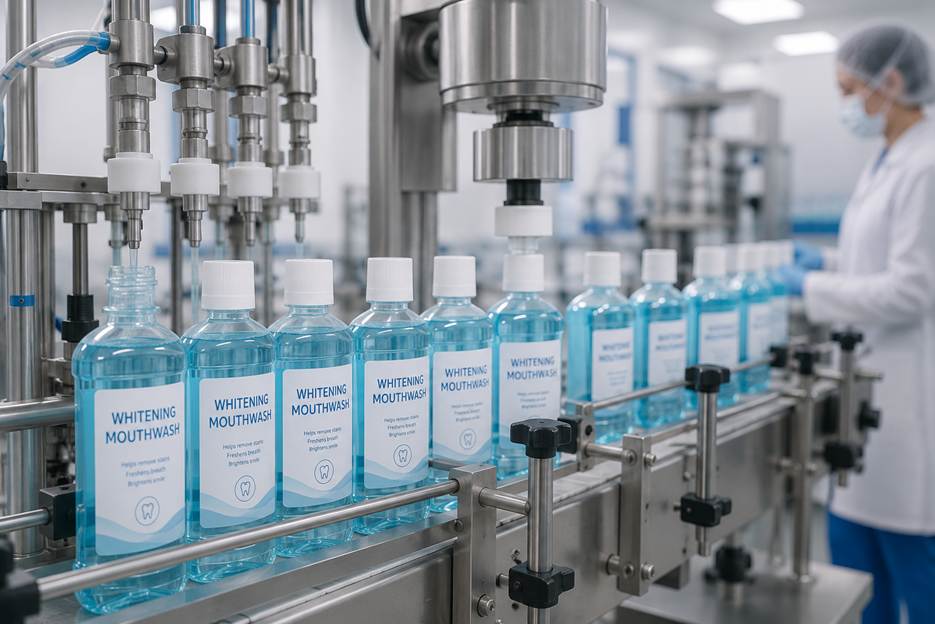
Once the formulation direction has been defined, manufacturers evaluate the formula, colour, bottle, closure, and packaging components as one complete product system. These decisions are made together because the finished product has to remain stable, perform consistently, and be suitable for commercial production.
A whitening mouthwash may have the right appearance when it is first developed, but manufacturers also need to evaluate how the formula performs over time in the selected packaging. Colour stability, packaging compatibility, and long-term product performance are reviewed together because changes in one area can affect the others.
For example, changing the bottle or closure after the formulation has already been validated may require another compatibility review. The manufacturer needs to confirm that the new packaging still supports the formula and its expected shelf-life performance before moving into commercial production.
To evaluate compatibility effectively, manufacturers typically review:
Reviewing these elements together helps identify potential issues before production planning begins. This is why manufacturers recommend confirming your packaging direction while formulation is still in development rather than waiting until the formula has already been approved.
Doing so allows compatibility to be evaluated earlier and reduces the likelihood of additional revisions before production.
Confirming the packaging direction early also allows compatibility evaluation and packaging preparation to progress together rather than as separate stages. This coordinated approach helps reduce unnecessary revisions, supports a more efficient development timeline, and makes it easier to move from formulation approval into commercial production.
The same planning approach applies when selecting a mouthwash packaging format, since packaging decisions influence compatibility, production planning, and the overall manufacturing process.
A whitening mouthwash may be designed to create a distinctive visual or sensory experience, such as controlled colour change, suspended visual elements, clouding during use, or a noticeable post-rinse appearance. These features can help communicate the product concept, but they are experience-design requirements—not evidence that the product whitens teeth or removes stains.
Whitening or stain-removal claims must be defined separately and supported by appropriate evidence for the destination market. A visible effect should never be used as a substitute for claim substantiation.
For benchmark-led concepts, an A/B prototype comparison can help separate the desired consumer experience from unnecessary formula complexity. One direction may follow the benchmark more closely, while a simplified control direction helps the brand judge which visual and sensory features are truly required before stability work begins.
When a project includes a visible-effect concept, the prototype should be evaluated as a complete system. Important checkpoints include:
Prototype acceptance confirms the preferred product direction. It does not by itself confirm production readiness, shelf life, or the approval of any whitening claim.
Receiving your first sample is not about deciding whether you like the flavour. It is your opportunity to confirm that the product still matches the vision you discussed with the manufacturer before moving closer to commercial production.
Start by comparing the sample against your original product brief. Ask yourself questions like:
If possible, use the sample more than once instead of making a decision after the first rinse. A product that makes a strong first impression may feel too intense after several uses, while a milder formulation may be better suited for a daily-use whitening mouthwash.
Looking at the sample over several days also gives you time to notice details such as flavour acceptance, overall user experience, and whether the product still aligns with your original concept.
For example, you may find that a stronger mint flavour creates a more premium impression, but it could also overpower the everyday whitening product you originally planned to launch. Likewise, a brighter colour may look more distinctive on the shelf, but it still needs to fit the image you want your brand to present.
Do not worry if the first sample is not exactly what you imagined. Sample evaluation is designed to identify refinements before commercial production begins, and it is common to go through one or more adjustment rounds before approving the final version.
A sample may be technically acceptable but still require refinement if it does not reflect the product experience your brand originally set out to deliver. For example, the formulation may perform as intended, but adjustments could still be needed to better support the planned whitening positioning, sensory experience, or market expectations.
Sample approval should confirm both technical performance and alignment with your overall product strategy.
Taking the time to evaluate the complete product rather than just the formula helps avoid revisions later in development. It also keeps the project moving more efficiently through the mouthwash development timeline once the final sample has been approved.
After evaluating a private label mouthwash manufacturer, it helps to prepare a clear project brief before contracting them. You do not need every technical detail finalized, but the more information you can provide, the easier it is for the manufacturer to evaluate your project and recommend the most suitable development path.
Before reaching out, it helps to have thought through:
Learn more about how to evaluate a private label mouthwash manufacturer.
Not every decision has to be confirmed at this stage. If some details are still under consideration, identify what has already been decided and what you would like the manufacturer to help you evaluate. For example, you may have finalized your target market and whitening positioning but still be deciding between a stock or custom formula, or comparing different packaging options.
Providing this information early allows the manufacturer to assess project feasibility, identify any decisions that could affect development, and recommend the most practical path before preparing samples or quotations.
It also makes it much easier to estimate your private label mouthwash cost because pricing is based on the specifications you have already defined rather than assumptions that may change later.
Whitening mouthwash is developed around the product’s intended positioning, planned claims, target market, and commercial objectives rather than around a single whitening ingredient. Manufacturers use this information to recommend the most suitable formulation direction before sample development begins.
Manufacturers start by understanding what you want the finished product to achieve. Factors such as your target market, desired whitening positioning, sensory expectations, and whether you need an existing or custom formulation all influence the development pathway.
Product claims guide formulation development from the beginning. Defining them early helps manufacturers recommend an appropriate formulation strategy and reduces the likelihood of revisions later if the product positioning changes.
Manufacturers review the formula, bottle, closure, and other packaging components as one product system because they all influence long-term product performance and commercial manufacturing. Changing packaging after formulation has been validated may require additional compatibility testing before production can proceed.
Evaluate samples against your original product brief rather than flavour or appearance alone. Use the sample several times, consider how it fits your target market, and confirm that it still supports the whitening positioning and customer experience you want your brand to deliver.
ORALABX’s standard commercial MOQ is 10,000 bottles per SKU. Final quantity is confirmed against the approved formula, packaging format and component minimums.
Prepare a clear project brief that includes your intended whitening positioning, planned claims, target market, preferred formulation direction, packaging preferences, estimated order quantity, artwork status if available, and expected launch timeline. The more complete your brief is, the easier it is for the manufacturer to evaluate feasibility and prepare accurate samples and quotations.
The strongest OEM projects begin with a clear product positioning, realistic claims, an appropriate formulation direction, and packaging that has been evaluated alongside the formula from the start. Making these decisions early helps reduce revisions and creates a smoother path into commercial production.
At ORALABX, we help brands evaluate formulation feasibility, packaging compatibility, and commercial manufacturing requirements before prototype development begins.
Ready to develop your whitening mouthwash?
Contact our manufacturing team to discuss your product positioning, formulation direction, packaging requirements, and production goals before sample development begins.
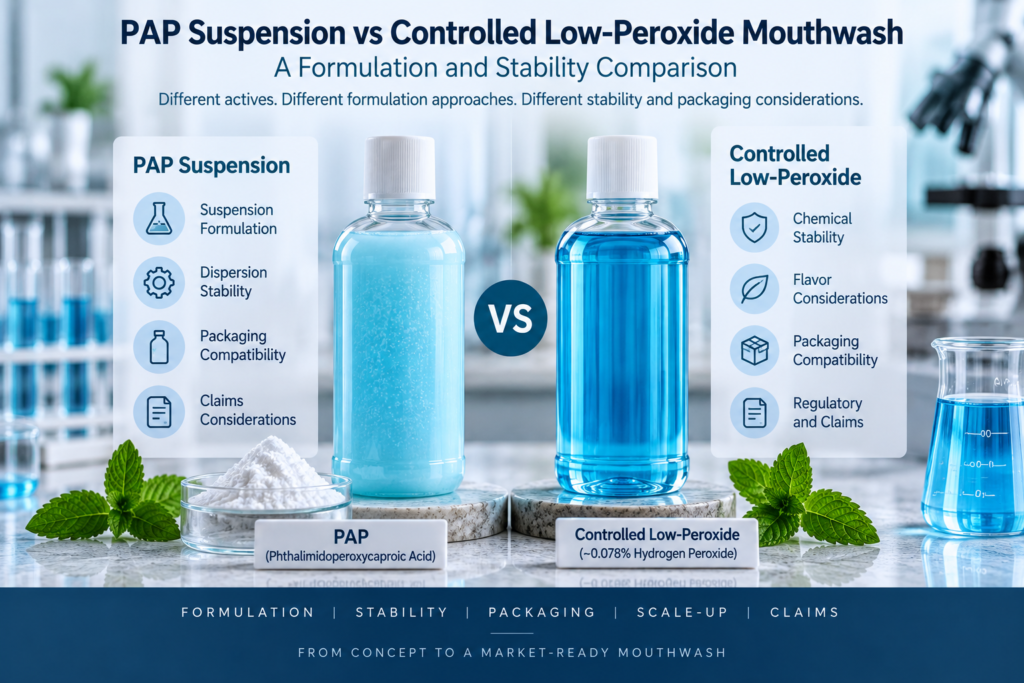
Whitening-positioned mouthwash does not follow one universal formulation route. Two commercially relevant directions are PAP suspension systems and controlled low-concentration peroxide systems. Each requires its own work on dispersion, appearance, flavor, stability observation, and packaging compatibility before commercial scale-up.
PAP is not treated as a simple clear-solution ingredient. A suspension project needs controlled dispersion, repeatable appearance, sensory adjustment, and observation for settling or separation. ORALABX has an anonymized mature-formula case with close to three months of room-temperature stability observation. This supports formulation capability, but it is not a promise of a specific consumer whitening result.
A mature low-peroxide base may be adapted through flavor adjustment or removal of a non-essential aromatic component without redesigning the complete system. The active level, packaging materials, closure, storage conditions, and destination-market claims still need project-specific review.
Review the whitening mouthwash manufacturing scope, the PAP suspension case study, and the controlled low-peroxide case study.
For the proposed project pathway, see the alcohol-free whitening mouthwash Development Brief, which separates formulation selection, sensory evaluation and packaging decisions from finished-product performance claims.

Share your product type, target market, estimated volume and launch timeline. We will review the project scope and recommend the appropriate development path.
Best suited to brands, importers and distributors planning scalable commercial production.