
Toothpaste

18 min read
July 24, 2026
Toothpaste
18 min read
July 24, 2026
In This Article
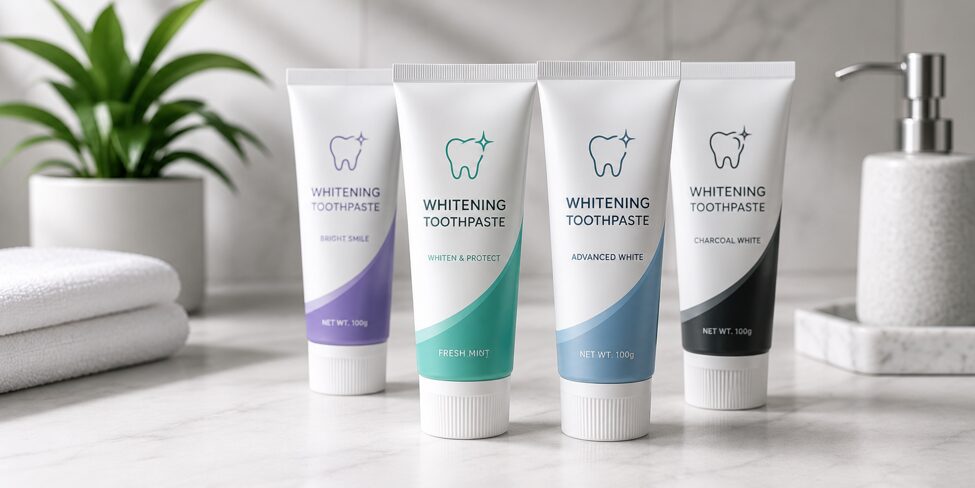
Developing a successful whitening toothpaste involves more than selecting whitening ingredients. Manufacturers also evaluate formulation direction, product claims, packaging, and target market requirements to create a consistent product.
Because these decisions are closely connected, whitening toothpaste development begins by defining a clear product direction before formulation work starts. Defining the product direction early helps reduce later changes to the formulation, product claims, tube selection, and the criteria used to evaluate production samples. .
This guide explains the key decisions involved in private label whitening toothpaste development and what brands should understand before working with a whitening toothpaste manufacturer.
In private label development, whitening toothpaste refers to a category of toothpaste that is formulated to deliver a whitening effect while remaining suitable for commercial manufacturing. Instead of using one standard formula, manufacturers develop different whitening toothpaste formulations based on the intended product requirements.
During development, whitening toothpaste is evaluated as a complete product. The formulation, intended claims, texture, flavour, abrasivity, and packaging are considered together because each can influence the product’s manufacturing performance and overall consistency.
For this reason, a whitening toothpaste manufacturer begins by defining the intended positioning before formulation work starts. This provides a clear foundation for developing a private label whitening toothpaste that can be evaluated, sampled, and prepared for the manufacturing stage.
Whitening toothpaste is not developed as a single standard formula. During OEM development, manufacturers first establish the intended whitening concept because different product objectives may require different formulation approaches, sensory profiles, product claims, and evaluation criteria.
Some whitening toothpaste projects are developed for everyday use, where the goal is to balance whitening performance with a comfortable daily brushing experience.
In these cases, manufacturers typically evaluate the overall formulation direction alongside abrasivity, flavour, foaming characteristics, and texture to support regular use and broad consumer acceptance. Sample evaluation also focuses on achieving a sensory profile that remains consistent with a daily-use product concept.
Other projects are developed around a stronger stain-removal or whitening concept. This direction may require different formulation approaches, more careful consideration of abrasivity, and closer review of the intended product claims.
Sample evaluation should confirm that the overall brushing experience remains consistent with the desired positioning while supporting the proposed product direction.
Whitening toothpaste may also be developed alongside other product objectives, such as sensitivity care or enamel protection. In these cases, manufacturers would check how whitening performance can be balanced with the additional product benefits through appropriate formulation choices, sensory characteristics, and product claims.
Sample evaluation considers whether these combined objectives work together as intended without compromising the overall product concept.
These positioning directions should not be viewed as variations of the same formula. Each may require different formulation decisions, claim strategies, and evaluation criteria before moving into commercial development.
Changing the whitening positioning after sample development may require another round of formulation review, claim assessment, and sample evaluation before production can proceed.
During OEM development, product claims are established before formulation work begins because they influence several decisions throughout the manufacturing process. Claims help determine how the product should be developed, evaluated, and prepared for production.
When planning a whitening toothpaste formulation, you should evaluate how the intended claims will affect:
Defining the intended product claims early provides a clearer direction for formulation planning, packaging development, and any testing or documentation that may be required. However, establishing the claims during development does not by itself confirm regulatory acceptance.
Final packaging wording and product claims should always be reviewed against the requirements of the destination market before production.
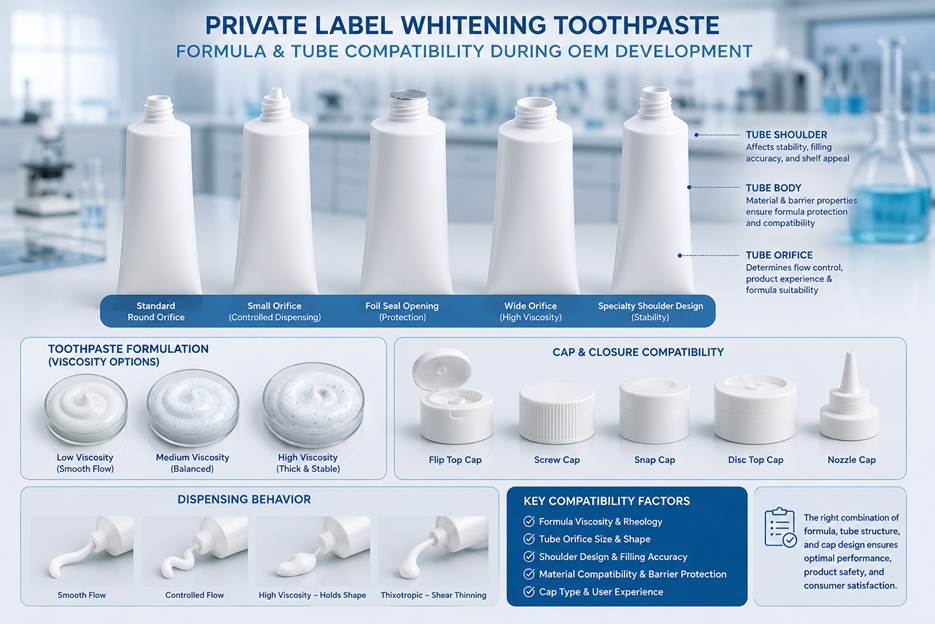
Developing a whitening toothpaste involves more than choosing between a stock or custom formula. The formulation, packaging, and user experience all influence whether a product can be manufactured consistently at commercial scale. For this reason, the manufacturer checks these elements together rather than as separate decisions.
Before formulation begins, manufacturers first define the intended whitening position and the formulation profile needed to support it.
This includes evaluating practical factors such as whether the product is positioned for everyday whitening or stronger stain removal, the appropriate abrasivity level, sensitivity expectations, flavour profile, foaming characteristics, and the overall user experience the product is intended to deliver.
Some brands may choose an existing stock formula to shorten development time, while others require a custom formulation tailored to specific product objectives. The appropriate approach depends on the level of customization, target market, and intended product positioning.
A laboratory sample should not only deliver the intended brushing experience but also remain practical for commercial manufacturing.
Whitening ingredients and abrasive systems can influence the toothpaste’s texture, density, viscosity, flow characteristics, and overall batch consistency.
During production scale-up, the paste’s aeration and deaeration behaviour can also influence its appearance, density, and filling consistency. These characteristics are evaluated during development to help ensure the formulation performs consistently under commercial manufacturing conditions.
These properties also affect how the toothpaste moves through commercial mixing equipment and filling lines. During development, manufacturers evaluate whether the approved formulation can be produced consistently while maintaining the same appearance, texture, and filling behaviour from one production batch to the next.
The toothpaste tube should be selected alongside the formulation rather than after it has been finalized. Factors such as the tube structure, shoulder design, cap style, and orifice size all influence how the toothpaste is dispensed during everyday use.
Manufacturers also evaluate how the selected tube performs with the formula’s colour, viscosity, and filling characteristics. Confirming tube compatibility early helps reduce the likelihood of packaging changes that could require additional filling or compatibility reviews later in development.
Foaming behaviour and flavour release are important parts of the overall brushing experience and should support the intended whitening positioning. Whether the product is designed for everyday whitening or a stronger stain-removal concept, the sensory experience should remain appropriate for its intended use.
During development, manufacturers evaluate how the foaming profile and flavour intensity work together with the formulation so the finished product delivers a consistent user experience while remaining suitable for commercial production.
Once your prototype sample is ready, take time to review it carefully before approving production. The sample gives you an opportunity to confirm that the product matches the concept you agreed on with your OEM whitening toothpaste supplier. It is much easier to make adjustments at this stage than after production has started.
When reviewing your sample, pay attention to the following:
Sample approval should mark the point where the major product decisions have been confirmed for production. Once the sample is approved, the formulation, packaging direction, intended claims, and evaluation criteria should be largely established so manufacturing can move forward without reopening fundamental development decisions.
If anything doesn’t meet your expectations, discuss it with your manufacturer before approving production. Resolving any remaining issues before production helps avoid formula adjustments or packaging changes after commercial manufacturing has been scheduled.
This step is an important part of custom whitening toothpaste development because it helps ensure that both the approved sample and the planned production process remain aligned with the agreed project specifications.
Preparing the right information before contacting a private label whitening toothpaste manufacturer helps make the development process more efficient. It also allows the manufacturer to recommend a suitable development approach, prepare more accurate quotations, and develop samples that match your intended positioning.
Before starting discussions with an OEM whitening toothpaste supplier, it’s helpful to prepare the following information:
Providing this information early creates a stronger starting point for the project. It enables your OEM manufacturer to evaluate the feasibility of your positioning, recommend the most suitable development approach, and prepare a quotation and sample plan.
An OEM manufacturer develops different whitening toothpaste formulations by first understanding the intended product concept, expected claims, target market, and level of customization required. This information guides formulation development, sample preparation, packaging decisions, and production planning.
Product claims are discussed early because they influence formulation decisions, ingredient selection, packaging wording, and regulatory considerations. Defining the intended claims before formulation begins helps guide these decisions and reduces the need to revisit them later in development. However, discussing proposed claims during development does not itself confirm regulatory acceptance or verify claim substantiation. .
Yes. Formula and packaging are usually developed together because they need to work as a complete product. Planning them at the same time helps reduce unnecessary revisions and supports a smoother manufacturing process.
During sample approval, brands typically review the formula, texture, flavour, appearance, packaging, and overall product experience. This stage provides an opportunity to request adjustments before production begins.
It’s helpful to prepare your product concept, intended claims, packaging preferences, target market, estimated order quantity, branding status, and expected project timeline. Providing this information allows the manufacturer to recommend a suitable development approach and prepare a more accurate quotation.
The timeline depends on your formulation and packaging requirements. As a general guide, formula development typically takes 7–14 working days, and prototype samples are usually prepared within 5–7 working days after the product direction has been confirmed.
Once the formula, packaging, and artwork are approved and materials are ready, finished toothpaste production typically takes around 45–60 days.
Successful whitening toothpaste brand development involves more than selecting a whitening formula. It requires coordinated decisions about formulation, product claims, texture, packaging, sample evaluation, and production planning to create a product that is ready for commercial manufacturing.
At ORALABX, we work with brands throughout every stage of the OEM development process, from formulation planning to production readiness.
Ready to develop your next private label whitening toothpaste? Contact our team to discuss your project and begin your OEM development journey.

Share your product type, target market, estimated volume and launch timeline. We will review the project scope and recommend the appropriate development path.
Best suited to brands, importers and distributors planning scalable commercial production.