
Toothpaste

17 min read
July 31, 2026
Home > Blog > Toothpaste > Nano-Hydroxyapatite Toothpaste Formulation: Concentration, Fluoride and Stability
Toothpaste
17 min read
July 31, 2026
In This Article
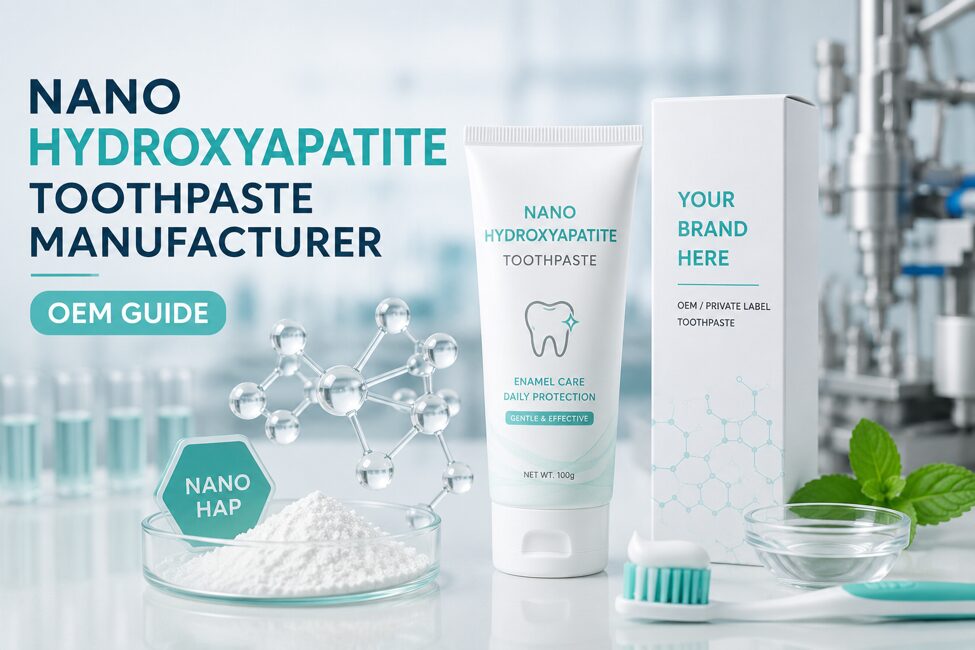
Nano-hydroxyapatite (n-HA) has moved from a niche ingredient to a mainstream formulation direction — but getting it right is a formulation problem before it is a production problem. The decisions that determine whether an n-HA toothpaste performs are made early: the concentration range, how particles stay dispersed in the paste matrix, whether and how fluoride is combined, and how stability holds over shelf life. This guide walks through each decision the way a formulation team would, so you can evaluate samples with clear criteria. This guide covers formulation decisions; for production capabilities, MOQ and sampling, see our nano-hydroxyapatite toothpaste manufacturing program.
Rather than treating nano-hydroxyapatite as a standalone selling point, manufacturers evaluate how it fits within the complete toothpaste formulation and the intended commercial concept. These decisions influence the supporting ingredients, documentation, packaging, and overall manufacturing strategy.
This guide explains how a nano hydroxyapatite toothpaste manufacturer approaches private label OEM development, helping brands understand the manufacturing decisions involved before requesting samples or quotations.
When a brand decides to develop a nano-hydroxyapatite toothpaste, it isn’t simply choosing an ingredient to add to a standard toothpaste formula. In private label development, nano-hydroxyapatite is treated as one part of a broader product concept.
Manufacturers consider how it fits within the overall formulation, the intended market positioning, and the commercial objectives of the product before formulation work begins.
This is because the same active ingredient can support different types of toothpaste. One brand may want a biomimetic daily care product, while another may be developing a sensitivity-focused toothpaste, a premium enamel support formula, or a fluoride-free option.
Although all of these products may contain nano-hydroxyapatite, they do not necessarily use the same formulation strategy, sensory profile, supporting ingredients, or documentation requirements.
For this reason, a nano hydroxyapatite toothpaste OEM project begins with defining the intended product direction rather than selecting ingredients in isolation. Manufacturers then determine how nano-hydroxyapatite should be incorporated into the complete formulation so that the product aligns with its positioning, manufacturing requirements, and commercial goals.
Before requesting a formulation, start by defining what you want the finished toothpaste to achieve in the market. For example, you may be planning a biomimetic daily care toothpaste, a sensitivity-focused product, a premium enamel support formula, or a fluoride-free option.
Having a clear product concept from the beginning helps keep the development process focused and reduces the likelihood of significant changes later in the project.
Sharing these goals with the nano hydroxyapatite toothpaste manufacturer early helps ensure the proposed development approach aligns with brand objectives instead of simply focusing on ingredient selection.
Once the product position is clear, OEM nHAp toothpaste development can move forward with a better understanding of the intended application, target export market, expected claims, and the user experience you want to deliver.
This information gives the manufacturer the context needed to recommend an appropriate formulation pathway, while decisions such as nano-hydroxyapatite concentration and fluoride inclusion are evaluated in greater detail during formulation planning.
Another important discussion is whether nano-hydroxyapatite will serve as the hero ingredient or as one component within a broader oral care concept. That decision shapes the overall development approach, influencing the formula design, sensory profile, documentation requirements, and the product’s commercial positioning.
It also helps guide how the finished product will be presented to the market and what supporting features may be incorporated into the overall formulation. It is not simply a question of selecting an active ingredient level.
Nano-hydroxyapatite concentration, fluoride strategy, and the destination market are closely linked during OEM toothpaste development.
When discussing a project with a nano hydroxyapatite toothpaste manufacturer, brands are typically asked to provide information such as:
Providing this information early gives the manufacturer a clearer understanding of the project’s technical and commercial objectives. However, these details serve as the starting point for formulation planning rather than confirmed technical specifications.
Before recommending a formulation, the proposed concentration is assessed alongside:
A brand may propose a preferred nano-hydroxyapatite concentration or use an existing product as a benchmark, but the final concentration direction will be determined only after these factors have been evaluated together.
These decisions are evaluated as part of the same development process because changing one may affect the others. For example, the destination market can influence ingredient requirements, the documentation needed to support the product, and the claims that may be appropriate for the finished product.
For projects intended for the European Union, qualifying nano-hydroxyapatite materials are currently permitted for cosmetic use at concentrations of up to 10%, subject to the applicable EU specifications and conditions.
This should not be interpreted as a universal approval rule or the recommended concentration for every formulation.
The raw material must also meet the applicable EU specifications and restrictions, and the manufacturer should review the supplier documentation, relevant particle characteristics, and the intended destination market before confirming that the proposed material is suitable for the project.
Brands should also recognize that formulation decisions involve practical trade-offs. A technically ambitious product may offer stronger market differentiation, but it usually requires additional development work, more supporting documentation, and a longer sample evaluation period before commercial production can begin.
Understanding these considerations early helps brands have more informed discussions with their OEM partner and establish realistic expectations for the development process.
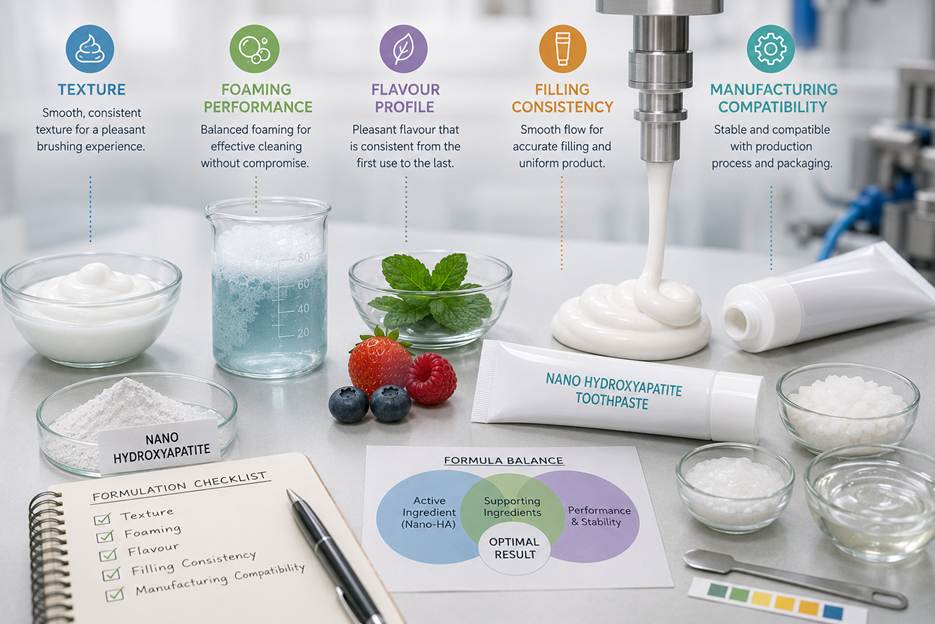
Nano-hydroxyapatite is only one part of the finished toothpaste. A successful formulation also depends on how the supporting ingredients work together to deliver the intended product experience while maintaining consistent manufacturing performance. During product development, manufacturers assess the complete formulation to ensure these elements complement one another instead of competing with the active ingredient.
Several formulation characteristics are reviewed together before production, including:
These characteristics are not developed independently.
Changing the nano-hydroxyapatite level or another part of the supporting formulation may require the manufacturer to reassess texture, flavour release, filling behaviors, and overall manufacturing compatibility before the formula is finalized.
Experienced manufacturers usually reassess the complete formulation after significant changes to the active ingredient level, because modifying one formulation parameter often affects multiple aspects of manufacturing performance.
Nano-hydroxyapatite toothpaste is often positioned around enamel care, remineralization support, sensitivity relief, or fluoride-free oral care. However, the claims used for the finished product should always correspond to the final formulation, the available supporting evidence, and the regulatory requirements of the intended market.
Some destination markets also have specific requirements regarding ingredient use, product classification, supporting documentation, and permissible marketing claims. Understanding these requirements early helps reduce unnecessary reformulation, documentation delays, or packaging revisions later in the development process.
During OEM development, the manufacturer can review formulation feasibility and provide available manufacturing or ingredient documentation to support the project. This information can help brands align product development with their intended market, but proposed claims should always reflect the final formula and the available supporting evidence.
Claims relating to disease treatment, cavity treatment, or enamel regeneration should not be used unless they can be appropriately substantiated and are permitted within the regulatory framework of the destination market.
However, the brand or its appointed responsible regulatory party remains responsible for destination-market claim approval, product notification where required, and final label compliance.
Establishing claims, documentation expectations, and regulatory responsibilities early in the development process helps reduce delays and supports a smoother transition from formulation to commercial production.
A prototype sample allows brands to confirm whether the proposed toothpaste aligns with the agreed product direction before commercial production begins. At this stage, the focus is on evaluating the product’s sensory characteristics and overall positioning rather than confirming full-scale manufacturing performance.
During sample evaluation, brands should review factors such as:
While prototype approval is an important milestone, it does not by itself confirm commercial production readiness. Depending on the project, additional technical reviews may be required before production begins, including packaging compatibility assessments, filling trials or production evaluations, and stability or other testing where applicable.
Documenting sample feedback clearly also helps minimize unnecessary reformulation cycles and supports a more efficient transition into commercial production.
The more complete your project information is, the easier it is for a private label nano hydroxyapatite toothpaste manufacturer to evaluate feasibility, recommend a suitable development approach, prepare representative samples, and provide a more accurate quotation.
Before starting OEM nHAp toothpaste development, manufacturers typically ask for information such as:
Providing this information at the beginning of the discussion helps reduce unnecessary revisions during development and allows both the brand and manufacturer to move through sampling and production planning more efficiently.
What concentration of nano-hydroxyapatite is typical in toothpaste?
— Most formulations work within an established range; the right level depends on positioning and the rest of the abrasive system, confirmed during formulation development.Can nano-hydroxyapatite be combined with fluoride?
— Yes. Combined systems exist, but the choice is usually driven by target-market regulation and positioning rather than chemistry alone.Why does particle dispersion matter?
— Poorly dispersed n-HA settles or aggregates, which affects both texture and consistency between batches.How is n-HA toothpaste stability tested?
— Through accelerated and real-time stability protocols covering texture, separation and active integrity over shelf life. Accelerated testing helps identify formulation risks early but does not replace real-time stability studies.Is nano-hydroxyapatite suitable for sensitive-teeth positioning?
— It is widely used in sensitivity-oriented formulations; claim wording must match each market’s cosmetic boundaries.What should I check when evaluating an n-HA sample?
— Texture and dispersion, flavor balance, foaming behavior, and whether the sample matches the agreed concentration direction.
Developing a successful nano-hydroxyapatite toothpaste involves more than selecting an active ingredient. Every project requires careful coordination between formulation planning, supporting ingredients, claims, documentation, sample development, and production readiness to ensure the finished product meets both commercial objectives and manufacturing requirements.
At ORALABX, we manufacture private label nano-hydroxyapatite toothpaste for brands at every stage of product development.
From evaluating formulation requirements and producing representative samples to commercial manufacturing and packaging, our team works to ensure each product is developed and produced in line with the project’s technical, regulatory, and commercial objectives.
To learn more about our toothpaste manufacturing capabilities or discuss your project requirements, please contact the ORALABX team.

Share your product type, target market, estimated volume and launch timeline. We will review the project scope and recommend the appropriate development path.
Best suited to brands, importers and distributors planning scalable commercial production.