In This Article

Alkaline mouthwash is a product concept built around a finished formula with a pH above neutral. For private label buyers, however, commercial development requires more than increasing pH. The buffering system, flavor, preservative efficacy, active compatibility, packaging, shelf-life performance, claims, and destination-market rules must work together.
This guide focuses on the manufacturing decisions importers and brands should resolve before requesting samples or approving mass production. It does not assume that a particular pH delivers a medical outcome; any benefit or efficacy claim must match the formula, evidence, product classification, and local regulations.
Begin with the target market, user profile, intended daily-use experience, alcohol position, active system, flavor direction, pack size, price tier, and claims. “Alkaline” alone is not a complete brief. Two products with the same measured pH can have very different sensory, stability, and regulatory profiles.
A stable specification matters more than a single laboratory reading. Formulators should select a buffering approach that maintains the agreed range through processing and shelf life without creating unacceptable taste, precipitation, haze, or incompatibility with other ingredients.
The development record should define the measurement method, sample temperature, instrument calibration, target, and acceptance range. Pilot and commercial batches should be checked against the same approved method. If pH is central to the product positioning, stability work should confirm how it changes under the agreed storage conditions.
Humectants, sweeteners, flavors, surfactants, botanical extracts, minerals, colorants, and active ingredients can interact with the buffer and preservation system. A change that improves taste may alter clarity or microbial robustness; a new extract may add color, sediment, or supplier-document requirements.
Alcohol-free formulas often require special attention to preservation, raw-material bioburden, process hygiene, and packaging. Preservative suitability should be assessed for the actual formulation rather than assumed from another product. Where required by the project, the test plan may include microbiological limits, preservative-effectiveness testing, stability, and packaging compatibility.
Higher-pH concepts can be difficult to balance for taste and mouthfeel. Sample evaluation should use a written scorecard covering first impact, sweetness, cooling, aftertaste, irritation perception, color, odor, clarity, and overall preference. Buyers should record approved reference samples and avoid approving only from informal comments.
Flavor houses may use compound systems with carriers and processing aids. Their documentation should be reviewed early when the project also has halal, allergen, natural-positioning, or market-specific requirements.
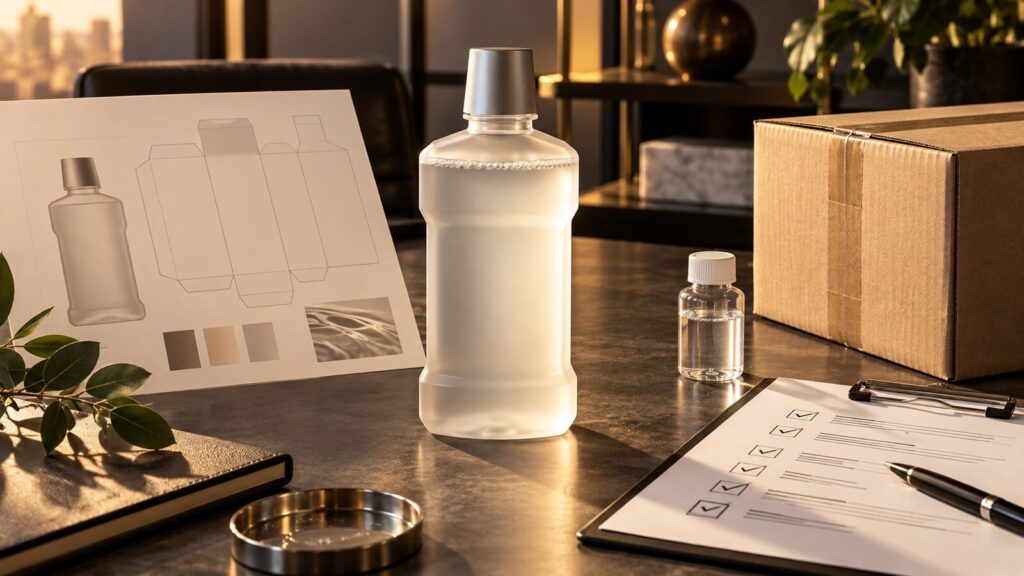
The bottle and closure form part of the product system. The manufacturer should evaluate contact compatibility, leakage risk, closure application, liner or induction seal, label adhesion, coding area, and transport conditions. A component that looks equivalent to a reference pack may behave differently on the filling line or during distribution.
Confirm component minimums, lead times, color tolerances, decoration method, tooling, and responsibility for transit testing before artwork approval. Packaging commitments should align with the expected commercial volume.
For the wider workflow, see the mouthwash manufacturing process and the comparison of stock and custom formula development.
Do not convert ingredient functions into finished-product medical claims. Terms relating to caries, gum disease, enamel repair, sensitivity, antibacterial action, or treatment can change the evidence and regulatory requirements. Review the finished wording for the specific market before packaging is printed.
A commercially reliable alkaline mouthwash depends on controlled pH, compatible ingredients, acceptable sensory performance, validated preservation, suitable packaging, and documented scale-up. Brands should evaluate the complete system and the evidence behind it, not select a supplier on pH or price alone.
ORALABX supports private label mouthwash formulation, sampling, packaging coordination, and commercial production. Final claims, testing, and documentation are agreed according to the formula and destination market.

Share your product type, target market, estimated volume and launch timeline. We will review the project scope and recommend the appropriate development path.
Best suited to brands, importers and distributors planning scalable commercial production.