
Toothpaste

20 min read
July 31, 2026
Home > Blog > Toothpaste > How to Develop Kids Toothpaste by Age Group: Fluoride, Flavor and Packaging
Toothpaste
20 min read
July 31, 2026
In This Article
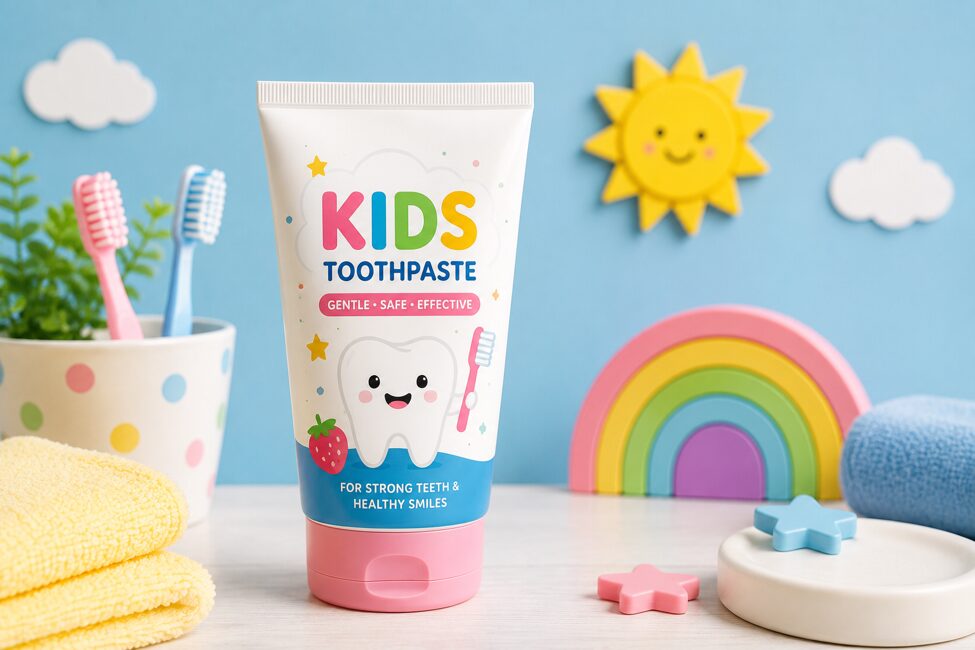
Kids toothpaste is not adult toothpaste in a smaller tube. Every major formulation decision — fluoride level, abrasive gentleness, sweetener system, flavor intensity, foam level — changes with the age group, because swallowing behavior, enamel maturity and taste acceptance all differ between a two-year-old and a ten-year-old. This guide breaks down how formulation logic shifts across age bands and what a complete product brief looks like. This guide covers formulation decisions; for production capabilities, MOQ and sampling, see our kids toothpaste manufacturing program.
A kids toothpaste manufacturer uses these project requirements to guide product development, helping brands create a toothpaste that aligns with their commercial objectives and manufacturing requirements.
This guide explains the key decisions involved in private label kids’ toothpaste development before requesting samples or starting an OEM project.
In practice, successful children’s toothpaste projects usually begin by defining the intended product specification before discussing flavours, colours or packaging concepts.
Private label kids’ toothpaste development begins by defining the product requirements before formulation, sample development, packaging, and commercial production move forward. Rather than adapting an adult toothpaste and applying children’s branding, the product is developed around the specific objectives of the project from the outset.
During the early planning stage, manufacturers work with brands to define key project inputs, including:
When developed as a private label kids’ toothpaste, the product is manufactured by an OEM partner and sold under another company’s brand. Rather than investing in their own manufacturing facility, brands work with an experienced manufacturer to develop a toothpaste that aligns with their product concept, commercial objectives, and target market.
This structured development process ensures that formulation, packaging, documentation, and production planning are aligned from the beginning, helping brands create a children’s toothpaste that reflects their market positioning while supporting efficient commercial manufacturing.
Before selecting ingredients or discussing flavours, manufacturers first establish who the product is being developed for and where it will be sold.
These decisions provide the foundation for the entire project because they influence many of the formulation, packaging, and production choices that follow. Without a clearly defined product direction, later development decisions become much easier to misalign.
One of the first questions a kids toothpaste manufacturer asks is the intended age group. A toothpaste developed for toddlers will have different formulation and product requirements from one designed for older children.
Once the age range has been defined, manufacturers can make informed decisions about flavour intensity, texture, foaming behaviors, active ingredient direction, packaging style, and the overall user experience.
Age group alone is not enough. Manufacturers also consider the intended sales channel, whether the product is being developed for mass retail, pharmacies, dental clinics, or premium natural brands.
The chosen sales channel helps shape the product’s market positioning, influencing how the formulation, packaging, claims, and overall presentation come together for the target market. Looking at these factors alongside the intended age group provides a clearer framework for developing custom kids’ toothpaste that aligns with the brand’s commercial objectives.
Different sales channels may also require different development decisions. For example, a pharmacy or dental-clinic product may require a different formulation position, documentation package, or claims approach than a product developed for mass retail or the premium natural market.
The intended channel can also influence flavour intensity, packaging presentation, target price, and packaging complexity, making it an important consideration during quotation and product development.
One of the key decisions in children’s toothpaste development is the product’s active ingredient direction. This refers to the primary ingredients that define the toothpaste’s intended function and product concept.
For many brands, the first discussion is whether the product will be developed as a fluoride toothpaste or a fluoride-free formulation, depending on the target market, brand positioning, and commercial objectives.
Fluoride direction and any permitted concentration should be determined according to the intended market, age positioning, and applicable product classification rather than applying a single approach to every project.
Neither approach is inherently better than the other. Fluoride-free is a product positioning choice, not automatically a safer option. The appropriate formulation direction depends on the product being developed, the intended age group, applicable market requirements, and the expectations of the brand.
Because the active ingredient strategy influences multiple aspects of development, manufacturers establish the overall formulation direction before refining the formula or preparing production samples.
However, the active ingredient strategy should not be finalized until the target market and intended product claims have been confirmed. This helps ensure the finished formulation, supporting documentation, and product positioning remain aligned with the project’s commercial and regulatory requirements.
Selecting an active ingredient strategy affects much more than the formula itself. It also provides guidance for other parts of the development process, including:
A fluoride kids toothpaste manufacturer considers these factors as part of one coordinated development process. The same approach applies when developing fluoride-free children’s toothpaste, with formulation, documentation, and product positioning planned together so the finished product is ready for commercial production.
A successful children’s toothpaste is developed around the complete brushing experience, not a single product feature. While flavour is often one of the first characteristics brands think about, manufacturers also consider sweetness, foaming behaviors, texture, paste colour, and visual appeal to create a product that is suitable for the intended age group.
These elements are developed together because each one contributes to how the product is perceived during use. A pleasant flavour alone may not create the desired user experience if the texture feels unpleasant, the foaming level is unsuitable, or the appearance does not align with the product concept.
The goal is to create a balanced formulation that delivers a consistent sensory experience while remaining compatible with commercial manufacturing.
When developing custom kids toothpaste, manufacturers typically balance several sensory elements at the same time, including:
These sensory characteristics are developed as one integrated system because changing one may require adjustments elsewhere in the formulation. For example, a very mild flavour may suit a toothpaste developed for younger children but may not align with the positioning of a product intended for older children.
Likewise, playful colours or flavours can strengthen the product concept, but they may also require additional compatibility, formulation consistency, and claim review to ensure they remain appropriate for the intended market and product positioning.
Considering these factors together helps manufacturers develop kids toothpaste formulations and packaging that deliver the intended sensory experience while supporting reliable commercial production.
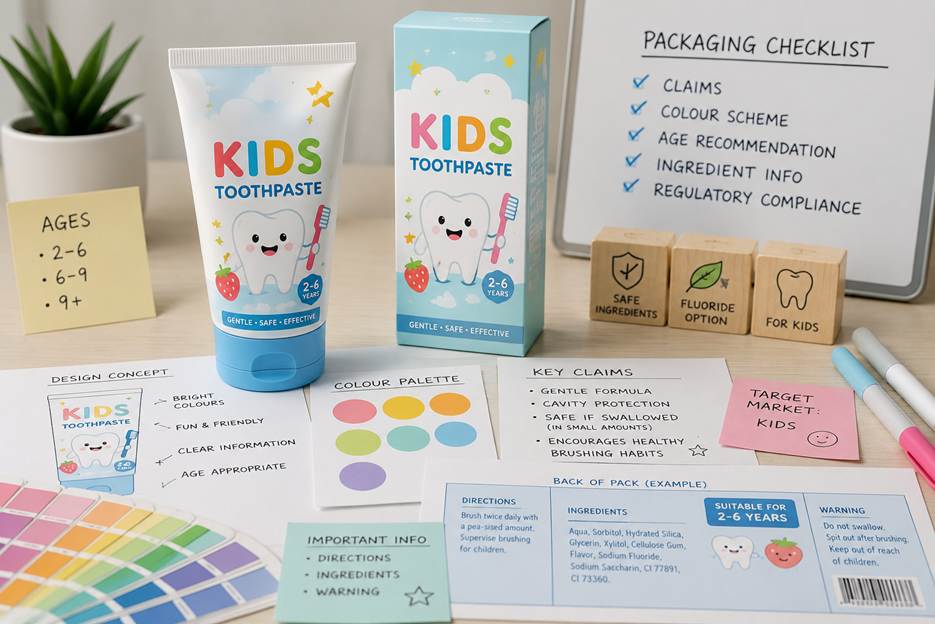
Packaging development for children’s toothpaste involves much more than creating an attractive design.
Every element, from the product claims and colour scheme to the age recommendation and required product information, should reflect the agreed formulation, packaging brief, and the requirements of the intended market. This helps create a product that is commercially consistent and supports efficient product development.
One point that often causes confusion is the use of words such as “safe.” On its own, “safe” is not a complete or differentiating product claim.
During product development, the manufacturer develops the product according to the agreed formulation and packaging brief and can provide available product and manufacturing documentation to support the project. However, the brand or its appointed responsible regulatory party remains responsible for final product claims, age-use instructions, label review, and destination-market compliance.
The approved formulation should guide the packaging strategy, not the other way around. Once the product concept, age positioning, and destination market have been established, manufacturers can recommend packaging elements that accurately represent the finished product and support its intended market position.
This also means avoiding messaging that creates unnecessary concern or makes unsupported comparisons. For example, fluoride-free, natural, or low-foam formulations should not automatically be presented as safer alternatives unless such claims can be appropriately supported for the intended market.
When developing private label kids’ toothpaste or an OEM children’s toothpaste project, manufacturers review the formulation, packaging, claims, and destination-market requirements together before production begins. This coordination helps reduce unnecessary revisions and creates a clearer pathway to commercial manufacturing.
A successful children’s toothpaste should meet the expectations of the market it is being developed for. While parents, retailers, and brand owners may each focus on different product attributes, these expectations help shape the project requirements that brands define before development begins.
For example, parents may expect an age-appropriate brushing experience, retailers may look for consistent product quality and attractive packaging, while brand owners often prioritize reliable manufacturing and commercial consistency. Rather than treating these as separate objectives, manufacturers use them to establish a clear product specification from the beginning of the project.
To support efficient product development, brands should clearly define key requirements such as:
Defining these requirements early helps reduce unnecessary revisions during formulation, packaging development, and production planning. The manufacturer’s role is to translate these expectations into a single producible specification that supports consistent commercial manufacturing, rather than attempting to satisfy each expectation independently.
Prototype samples allow brands and manufacturers to confirm that the product reflects the agreed formulation direction and overall product concept before commercial production begins. Reviewing a prototype gives brands the opportunity to evaluate the product’s sensory characteristics and identify any refinements before production starts.
Addressing feedback during the sampling stage is generally more efficient than making changes after commercial manufacturing has begun. However, prototype approval should not be interpreted as confirmation that the product is fully validated for large-scale production.
When assessing prototype samples, brands should:
Following buyer sample approval, the manufacturer may also complete additional technical assessments, where applicable, before commercial production. These may include confirming filling behaviors, tube compatibility, production specifications, and any required stability or other testing for the project.
By separating sensory sample approval from technical production validation, manufacturers and brands can refine the product while supporting a smoother transition into commercial manufacturing.
Before requesting a quotation, it’s helpful to define the key requirements for your children’s toothpaste project. The more complete your project information is, the easier it is for a private label kids toothpaste manufacturer to understand your product objectives, recommend a suitable development approach, and prepare an accurate quotation.
While every project is different, manufacturers typically request information such as:
Providing this information from the beginning allows the children’s toothpaste OEM supplier to recommend an appropriate development pathway, prepare representative samples, and plan commercial manufacturing more efficiently.
Based on the agreed product requirements, packaging system, and production approach, the manufacturer can then confirm the applicable minimum order quantity (MOQ). Early planning also helps reduce unnecessary revisions as the project moves forward.
How does fluoride level change by age group?
— Recommended levels differ between toddlers, young children and older kids, and destination-market rules set the ceiling; the strategy is fixed at the brief stage.
Are fluoride-free kids toothpastes viable?
— Yes; fluoride-free systems built around alternative actives are an established direction for specific market positionings.
Why is xylitol common in kids formulations?
— It provides sweetness without fermentable sugar, supporting taste acceptance in low-foam, mild-flavor systems.
Why do kids toothpastes foam less?
— Lower foam reduces swallowing risk and improves the brushing experience for younger children.
What flavor directions work best for children?
— Mild fruit systems dominate; intensity is tuned down versus adult products, and flavor is always validated on the actual base formula. Sweetness is usually adjusted together with flavour rather than treated as a separate decision.
What packaging safety points apply to kids toothpaste?
— Cap design, tube opening size and child-appropriate dosage guidance on pack are the recurring review points.
Developing a successful children’s toothpaste requires more than selecting a flavour or choosing between fluoride and fluoride-free formulations. Every project involves coordinating age-group requirements, formulation direction, sensory design, packaging, claims, documentation, and sample evaluation to create a product that is ready for commercial production.
At ORALABX, we manufacture private label kids’ toothpaste for brands looking to develop products for different age groups and market segments.
From formulation development and prototype sampling to commercial manufacturing and packaging, our team works with customers to produce children’s toothpaste that aligns with the project’s technical, regulatory, and commercial requirements.
To learn more about our kid’s toothpaste manufacturer capabilities or discuss your project requirements, please contact the ORALABX team.
ORALABX manufacturing scope: ORALABX supports U.S. cosmetic oral-care manufacturing only. We do not manufacture U.S. OTC drug products, including fluoride anticavity toothpaste or therapeutic rinses. Product classification, claims and local regulatory responsibility must be confirmed before development.

Share your product type, target market, estimated volume and launch timeline. We will review the project scope and recommend the appropriate development path.
Best suited to brands, importers and distributors planning scalable commercial production.