
Toothpaste

24 min read
July 31, 2026
Toothpaste
24 min read
July 31, 2026
In This Article
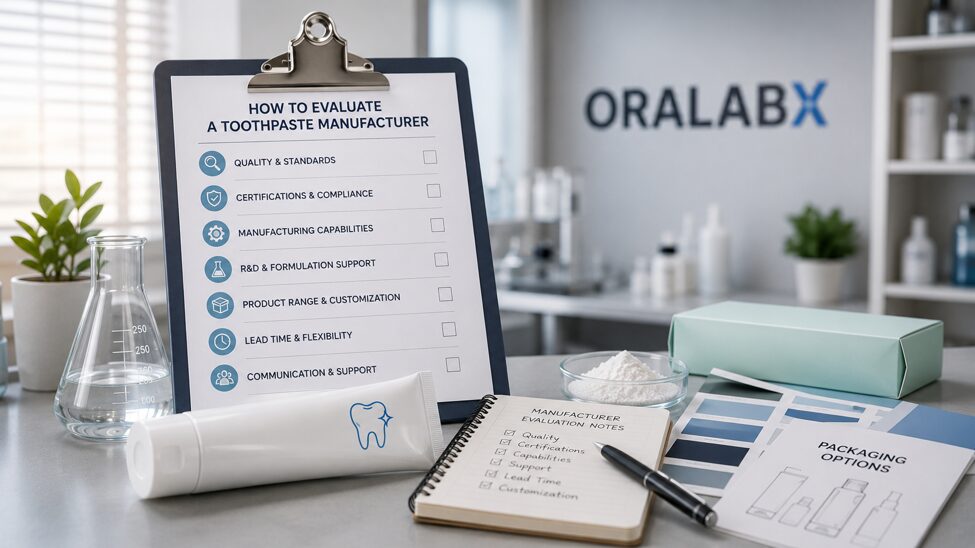
Selecting a toothpaste manufacturer is one of the most important decisions in a private label project. While certifications, quotations, and production capacity are all worth reviewing, they do not provide the full picture of whether a manufacturer is the right fit for your product.
Every toothpaste project has its own technical and production requirements. Evaluating an OEM partner therefore involves understanding whether they have the manufacturing capability to develop, produce, package, and consistently reproduce the toothpaste you want to bring to market.
This toothpaste manufacturer evaluation guide explains the practical areas buyers should assess before choosing an OEM partner.
Many buyers begin by comparing manufacturers using the same checklist: certifications, production capacity, minimum order quantities, lead times, and pricing. While these are all important considerations, they do not answer the most important question: Can this manufacturer successfully produce the toothpaste I want to develop?
A manufacturer should always be evaluated against the specific project, not against a general supplier checklist.
For example, if your goal is to launch a fluoride-free toothpaste for children, the right manufacturing partner should have experience developing gentle formulations, balancing flavour for younger users, and producing that type of product consistently at commercial scale.
By comparison, a premium whitening or nano-hydroxyapatite toothpaste may require different experience with raw material handling, texture and abrasivity management, flavour balancing, tube selection, supporting documentation, and production controls. A factory that excels in one type of toothpaste may not necessarily have the same experience with another.
Once the project has been clearly defined, it becomes easier to evaluate whether a manufacturer has the technical capability to support it. Factors such as the formulation, active ingredients, abrasivity level, flavour system, tube specifications, filling process, and overall production complexity all influence what the manufacturer needs to do to deliver a consistent product.
These requirements also determine whether the factory’s equipment, development experience, and production processes are suitable for the project.
A thorough toothpaste manufacturer evaluation therefore begins with the toothpaste you want to manufacture. Assessing manufacturers against your project’s technical requirements provides a far more meaningful evaluation than relying on a generic supplier checklist alone.
If you’re evaluating manufacturers for liquid oral care products, our Private Label Mouthwash Manufacturer Evaluation Guide explains the different considerations involved in mouthwash production.
A manufacturer’s formulation and technical capability determine whether the proposed toothpaste can be developed, refined, and reproduced consistently for commercial production. This evaluation should focus on the specific toothpaste project because different formulations require different levels of technical knowledge and manufacturing experience.
A manufacturer that has successfully developed one type of toothpaste may not necessarily have the expertise required for another. Rather than reviewing a long list of individual capabilities, buyers can evaluate technical competence by asking three practical questions.
Look for experience with projects that have comparable formulation requirements, target users, active ingredients, or product positioning. Similarity is more meaningful than simply confirming that the manufacturer produces toothpaste.
Experience with comparable projects often provides a stronger indication that the manufacturer understands the formulation, abrasively, flavour, texture, and production requirements involved.
An experienced manufacturer should be able to explain why certain formulation decisions are recommended, what practical alternatives are available, and what technical limitations should be considered before development begins.
This includes discussing how active ingredients may influence formulation compatibility, stability requirements, texture, flavour, processing, supporting documentation, and permitted product positioning, rather than simply describing their intended function.
The discussion should also cover practical considerations such as abrasively, viscosity, and ingredient interactions where they affect manufacturing and product development.
Developing a successful laboratory formula is only part of the process.
The manufacturer should also demonstrate how the approved formulation can be reproduced consistently during commercial manufacturing through appropriate production controls, viscosity management, and batch repeatability.
The objective is to ensure that the approved formulation can be manufactured consistently at production scale, not just prepared successfully as an initial sample.
Technical capability is demonstrated through both manufacturing experience and technical discussions. A manufacturer that can explain its recommendations, discuss potential limitations, and describe how an approved formulation is transferred into consistent commercial production provides a stronger indication of manufacturing capability than simply confirming that it produces toothpaste.
Manufacturers that immediately agree with every technical request do not necessarily demonstrate stronger capability. Experienced OEM partners usually explain technical trade-offs before recommending the most practical development approach.
Producing a high-quality sample is only part of a manufacturer’s capability. Commercial production requires the same formulation to be reproduced consistently from one batch to the next. Stable manufacturing processes and effective production controls help maintain the product’s appearance, texture, and performance throughout repeated production runs.
When evaluating a manufacturer’s production capability, the following areas should be reviewed:
Reliable toothpaste manufacturing capability is reflected in consistent production, not isolated results.
Manufacturers should be able to explain how their production controls support repeatable quality, how viscosity relates to paste transfer and tube filling, and, where relevant, how air incorporation is managed during production.
These discussions give buyers a clearer understanding of how approved samples are translated into stable commercial batches without requiring disclosure of confidential manufacturing processes.
A toothpaste manufacturer should be able to coordinate packaging activities as part of the production process.
Once the formulation is ready for commercial manufacturing, the tube, filling equipment, sealing process, decoration, and secondary packaging all need to work together to produce a finished product that is ready for the market. Weak coordination at any of these stages can affect production efficiency, product quality, and delivery timelines.
Before artwork is finalized and tube production is released, the project should confirm that the selected tube and the approved formulation remain suitable for one another. This typically includes reviewing the tube material and size, cap and orifice configuration, filling and sealing suitability, decoration method, carton dimensions, and formulation compatibility where relevant.
Confirming these elements together helps reduce unnecessary revisions if packaging or formulation changes are required later in development.
When evaluating a manufacturer’s packaging capability, the following areas should be reviewed:
A visually preferred tube may not always be the most practical choice for the formulation, filling line, or minimum order quantity requirements. Evaluating packaging capability alongside formulation and production planning helps manufacturers recommend packaging solutions that support reliable commercial manufacturing as well as the intended product presentation.
A manufacturer that coordinates sourcing, filling, sealing, decoration, and packaging efficiently is better positioned to deliver products that are production-ready and commercially consistent. This is an important part of any private label toothpaste supplier evaluation and toothpaste OEM factory checklist.
Sample development provides an opportunity to refine the product before commercial production begins. It also allows buyers to evaluate how the manufacturer manages product development, responds to feedback, and prepares approved formulations for large-scale manufacturing.
An organized sampling process reduces uncertainty and helps establish a smoother transition into production. However, buyers should also recognize that a laboratory sample is typically prepared at a different scale from commercial manufacturing.
Before production begins, the approved sensory characteristics and formulation specifications need to be translated into production instructions and batch controls so they can be reproduced consistently during large-scale manufacturing.
If formulation, packaging, or project requirements change after sample approval, the manufacturer may need to review and update these production preparations before manufacturing proceeds.
When reviewing a manufacturer’s sampling and development process, the following areas should be considered:
An experienced manufacturer uses the development stage to identify potential technical issues, recommend practical solutions, and establish a clear production standard before commercial manufacturing begins.
While an approved sample provides an important reference for production, it should not be interpreted as a guarantee that full-scale manufacturing requires no further technical review or production preparation.
Manufacturing capability extends beyond producing the finished toothpaste. Buyers should also confirm what documentation and export-related support the manufacturer can provide as part of the manufacturing project, as well as which regulatory activities remain the responsibility of the brand or its appointed responsible regulatory party.
Clarifying these responsibilities early helps prevent delays once the product is ready for shipment.
When evaluating a manufacturer’s documentation and commercial support, the following areas should be reviewed:
Buyers should also confirm which activities remain outside the manufacturer’s scope. Responsibilities such as product registration, responsible-person arrangements, destination-market label approval, and market authorization are typically managed by the brand or its appointed responsible regulatory party unless otherwise agreed.
Understanding these responsibilities before production begins allows buyers to plan more effectively and avoid unnecessary delays once manufacturing has been completed. This is an important consideration when conducting a private label toothpaste supplier evaluation or comparing a toothpaste contract manufacturer with other OEM partners.
Comparing quotations from different manufacturers is an important part of supplier evaluation, but the unit price alone rarely provides a complete basis for comparison.
Manufacturers may include different products, services, packaging components, and development activities within their quotations. Understanding the scope of each quotation makes it easier to compare suppliers fairly and identify what is actually being offered.
When reviewing a manufacturer’s quotation, the following areas should be confirmed:
A meaningful comparison looks beyond the final price. For example, one manufacturer may provide a lower quotation based on a standard tube, stock cap, and an existing formulation, while another quotation may include custom formulation development, specialized packaging, and additional production support.
Although the second quotation may be higher, it may also cover a much broader project scope.
Comparing quotation assumptions, exclusions, and buyer responsibilities before comparing unit prices provides a clearer understanding of the value each manufacturer is offering. This approach helps buyers choose an OEM toothpaste supplier based on the complete manufacturing scope rather than price alone.
A manufacturer evaluation should identify not only strengths but also potential risks. Delays, unexpected costs, and production issues often stem from problems that were already visible during the early stages of the project.
Recognizing these warning signs allows buyers to address concerns before committing to a manufacturing partner.
The following issues may indicate gaps in technical capability, project management, or manufacturing support:
These warning signs do not always mean a manufacturer is unsuitable, but they should encourage further discussion before moving forward. An experienced OEM partner should be able to explain its development process, define the project scope clearly, and communicate technical recommendations with confidence.
Asking practical questions gives buyers a better understanding of the manufacturer’s technical capability, development process, production planning, and ability to support the specific toothpaste project.
These discussions also make it easier to compare manufacturers on the scope of their support instead of price alone.
These questions help buyers understand how to evaluate a private label toothpaste manufacturer beyond certifications or pricing. They also provide a practical way to compare technical expertise, communication, project management, and overall toothpaste manufacturer capability before selecting an OEM partner.
Selecting the right toothpaste manufacturer involves evaluating formulation expertise, production consistency, packaging coordination, documentation support, and commercial planning as part of a complete manufacturing process.
Looking at these capabilities together provides a clearer understanding of whether an OEM partner can successfully deliver the specific toothpaste project being planned.
At ORALABX, we help brands evaluate these requirements before product development begins. From formulation development and sample refinement to packaging coordination and commercial manufacturing, our team works with customers to build production-ready toothpaste products that are aligned with their technical and commercial objectives.
Learn more about our Toothpaste Manufacturing Services or contact our team to discuss your private label toothpaste project.

Share your product type, target market, estimated volume and launch timeline. We will review the project scope and recommend the appropriate development path.
Best suited to brands, importers and distributors planning scalable commercial production.