In This Article
One of the biggest mistakes you can make as a new mouthwash brand is requesting samples from a supplier before fully evaluating them. Rushing into the sampling phase puts your timeline at risk. You can easily spend weeks going back and forth on custom formulations and packaging options, only to discover issues later.
You might find out too late that the manufacturer’s minimum order quantity (MOQ) is far outside your budget. Or worse, you discover their certifications are outdated, or they have never actually run a dedicated oral rinse line before.
Before you ask a facility to ship out physical products, you need to do some foundational homework.
This guide walks you through exactly how to evaluate a private label mouthwash manufacturer upfront. By taking these steps first, you ensure that by the time samples finally arrive, you are already dealing with a partner capable of bringing your product to market.
Jumping straight to samples seems like the fastest path forward, but it skips the crucial qualification steps that protect your timeline and your budget. In oral care manufacturing, evaluating a partner must be the very first step in your sourcing process to ensure compatibility.
Working with a dedicated mouthwash manufacturer from day one gives you several distinct advantages:
When you do a proper evaluation, you enter the sampling phase with a better foundation, knowing the manufacturer is fully capable of bringing your specific project to life.
To keep your qualification process objective, use this operational framework to vet candidates before moving to the lab phase. Rather than just reviewing surface-level capabilities, you must evaluate the underlying technical mechanisms that dictate production success.
| Evaluation Metric | What to Verify | Why It Matters | Risk Reduced | Supplier Selection Impact |
| Line Specialization | Dedicated liquid oral rinse lines vs. shared cosmetic lines. | Mouthwash requires precise surfactant levels and strict microbiological controls compared to thick topicals like lotions. | Cross-contamination and formulation instability (phase separation). | Eliminates generic cosmetic factories; isolates true oral care specialists. |
| MOQ Structuring | Minimum run requirements per SKU vs. total order volumes. | High-speed automated filling lines require substantial liquid volumes to maintain stable pump pressure. | Tied-up working capital and excess unsold inventory. | Filters out facilities whose mechanical scale doesn’t match your business phase. |
| Regulatory Credentials | Active ISO 22716, FDA FEI registration, and current audit histories. | Validates that the facility uses validated sanitization chemistry and traceable batch recording. | Customs seizures, product recalls, and compliance litigation. | Acts as an immediate binary filter; uncertified facilities are rejected. |
| Thermal & Packaging Stability | In-house vacuum leak testing and incubator compatibility protocols. | Alcohol and volatile flavor oils degrade substandard plastics and liner adhesives over time. | Leaking closures, collapsed bottles, and flavor scalping. | Prioritizes manufacturers with built-in engineering support over simple packagers. |
| Compounding Capacity & Lead Time | Mixing tank volume ceilings and seasonal calendar congestion. | Total batch throughput is limited by the physical cooling/heating cycles of jacketed tanks. | Launch delays, supply gaps, and missed retail delivery windows. | Identifies partners who can scale from pilot batches to full truckloads. |
Let’s get into the details.
Private label services are not the same across the industry. Some facilities operate on a rigid model, offering standard stock formulas with almost zero room for adjustment. Others provide a flexible framework that allows you to tweak active ingredients and sensory profiles.
Before requesting physical samples, you must audit their production setup to ensure it aligns with your brand goals. This step reduces the risk of investing weeks into a specific product concept only to realize the factory floor cannot physically execute it.
When assessing program fit, evaluate these mechanical variables:
Confirming all these details now ensures you don’t discover these limitations halfway through development.
Minimum Order Quantity (MOQ) is the most practical filter you can apply at the start of your supplier search.
While it is easy to view a high MOQ as an obstacle, reputable manufacturers set these limits because oral care production demands strict quality control, extensive line sanitization, and raw material minimums from upstream suppliers.
Understanding the operational math behind an MOQ reduces the risk of overextending your capital or getting trapped with dead stock. It directly influences your supplier selection by identifying factories whose machinery scales efficiently at your target volume.
To properly evaluate MOQ compatibility, walk through these three steps during your initial discussions:
If your strategy requires an MOQ flexible bulk mouthwash supplier that can deliver retail-ready quality without forcing your brand into massive upfront inventory commitments, establishing these volume targets early helps prevent development bottlenecks.
General cosmetic manufacturing and oral care production are entirely different fields. A facility that runs body wash, lotion, or shampoo all day long is rarely equipped to handle the strict chemistry, stabilization, and micro-testing required for a high-quality oral rinse.
To vet a private label mouthwash supplier properly before requesting a single sample, focus your evaluation on these four operational areas:
Verifying this technical depth early protects your brand from major development delays, unexpected stability failures, and costly production inefficiencies down the line. If your project involves regulated retail, DTC, or multi-channel distribution, choosing the right mouthwash contract manufacturer also helps ensure that formulation support, packaging compatibility, MOQ planning, and production documentation are evaluated before samples are requested.
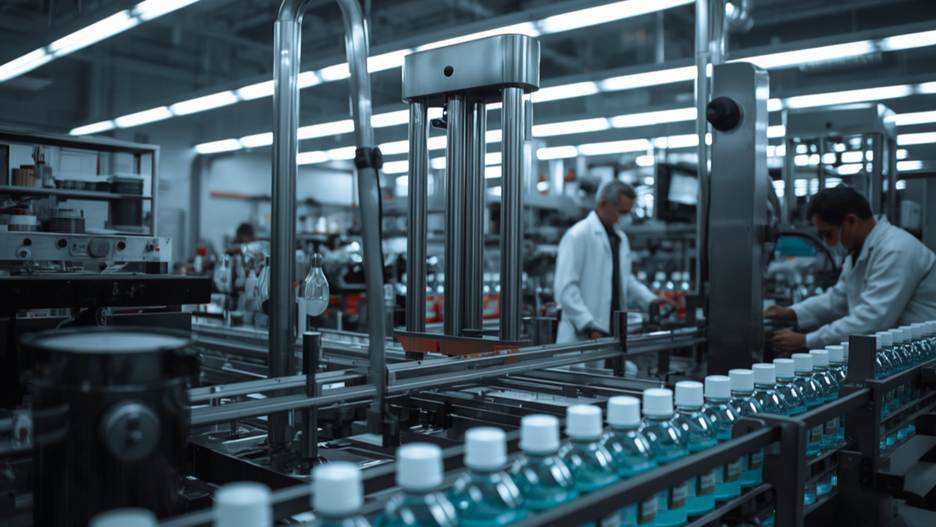
A manufacturer that can easily hand-mix a pilot batch in a lab can completely fall apart when it is time to scale up for retail. Capacity constraints and lead times are details most buyers ignore until after samples are approved, but ignoring them early puts your entire supply chain at risk. If you cannot get predictable restocking schedules, you face stockouts, delayed launches, and broken retail relationships.
To build a reliable supply chain, you must evaluate both their current floor capacity and their operational planning before ordering samples.
On the capacity side, ask about:
On lead time, get specifics on the following:
Understanding these timelines early is exactly how successful brands avoid building a supply chain based on assumptions. In our experience managing complex production runs, these operational details make or break a launch.
Read our oral care manufacturer qualification case study for a detailed look at how proper operational auditing protects your timeline.
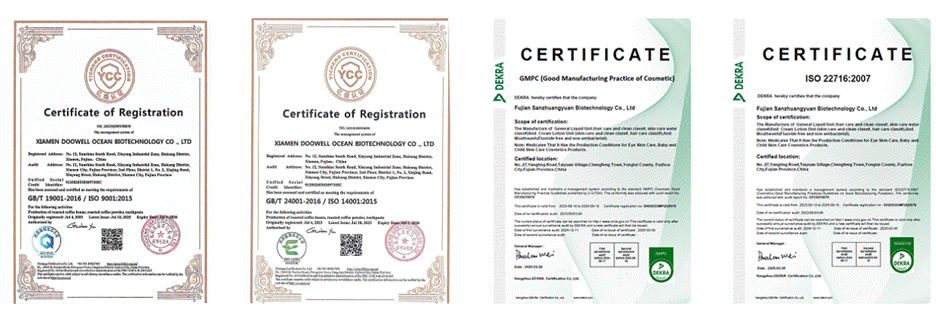
Certifications do not guarantee perfect production on their own, but they do tell you if a facility meets the baseline legal and safety standards required for your market. Skipping this verification step early can freeze your inventory at customs and completely tank your launch timeline.
To protect your investment, request and review these three foundational credentials before moving to the sample phase:
You can securely request these credentials by asking for the factory’s standard supplier qualification documents during your initial vetting process. A manufacturer that makes its regulatory paperwork easy to review is generally one that keeps its facility consistently maintained and audit-ready. For buyers preparing retailer review or import documentation, documented mouthwash testing and quality controls can help make certifications, batch records, testing data, and compliance files easier to verify before the sampling stage.
You do not need to visit a facility in person to conduct meaningful due diligence. A well-structured virtual evaluation can tell you a great deal about a manufacturer’s capabilities and how they manage client relationships, and it helps you narrow your shortlist before committing additional time and resources to the process.
During a virtual evaluation, work through the following:
To help brands simplify this initial step, we make our technical data completely transparent. You can download our manufacturing capability overview to review our equipment specs, cleanroom standards, and production thresholds before you ever jump on a call with our team.
By completing this virtual screening first, both sides enter the sampling phase with crystal-clear expectations, which significantly accelerates your time to market.
How a facility manages sample development from brief to delivery often reflects exactly how they manage full production runs, and the patterns you see early tend to repeat themselves throughout the relationship.
When assessing a manufacturer’s approach to sampling, look at these indicators:
A structured, well-documented sample process usually means a structured production operation behind it. For instance, if a full custom mouthwash formulation supplier cannot explain clearly how they manage custom mouthwash formulation from inquiry through to sample delivery, that lack of clarity tends to carry forward into everything that follows.
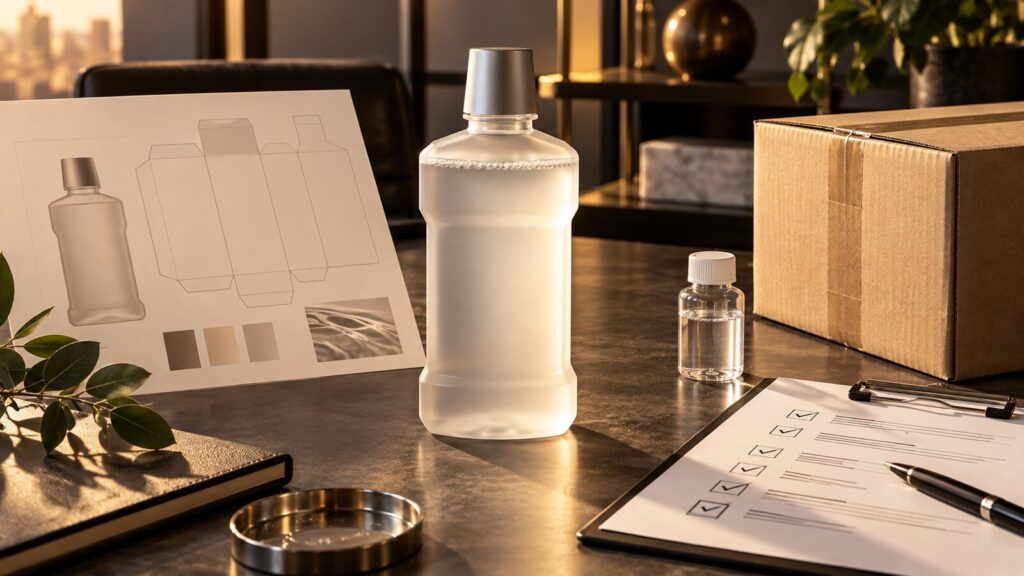
A sample should confirm an agreed product direction; it should not replace the work of defining the project. Before requesting samples, prepare enough information for the manufacturer to assess technical fit, commercial fit, packaging availability, and the applicable documentation path.
A project is normally ready when the destination market, product direction, benchmark or sensory brief, packaging direction, commercial quantity, responsible decision makers, and realistic schedule are clear. Projects requiring US OTC drug claims, therapeutic mouthwash positioning, an undefined low-volume trial, or sampling without a commercial brief require further qualification before development.
Once the brief and reference direction are confirmed, standard samples are usually prepared in 5–7 working days. Commercial production normally requires 45–60 days after the formula, packaging, artwork, and deposit are confirmed. Review the complete custom mouthwash formulation scope, sample process, and OEM project workflow before requesting development.
A focused comparison of three to five suppliers is usually enough to make a well-informed decision. The goal is not to collect as many options as possible but to qualify a small shortlist thoroughly before investing time in sample development.
Review the quality systems, certifications, facility registrations, and manufacturing documents that are relevant to the product and destination market. FDA facility registration alone is not product approval, evidence of US OTC manufacturing capability, or confirmation that a proposed claim is permitted.
Our standard sample turnaround is usually 5–7 working days after the brief and reference direction are confirmed. More complex custom development may require an agreed development phase before the standard sample clock begins.
MOQ varies significantly between facilities and packaging formats. At ORALABX, you can expect an MOQ of around 10,000 bottles for standard retail bottles. For travel sachets or single-use cups, the requirement is around 100,000 units due to high-speed automation requirements. These baselines can change depending on your specific formulation or custom packaging needs, but we establish these numbers clearly during your initial evaluation.
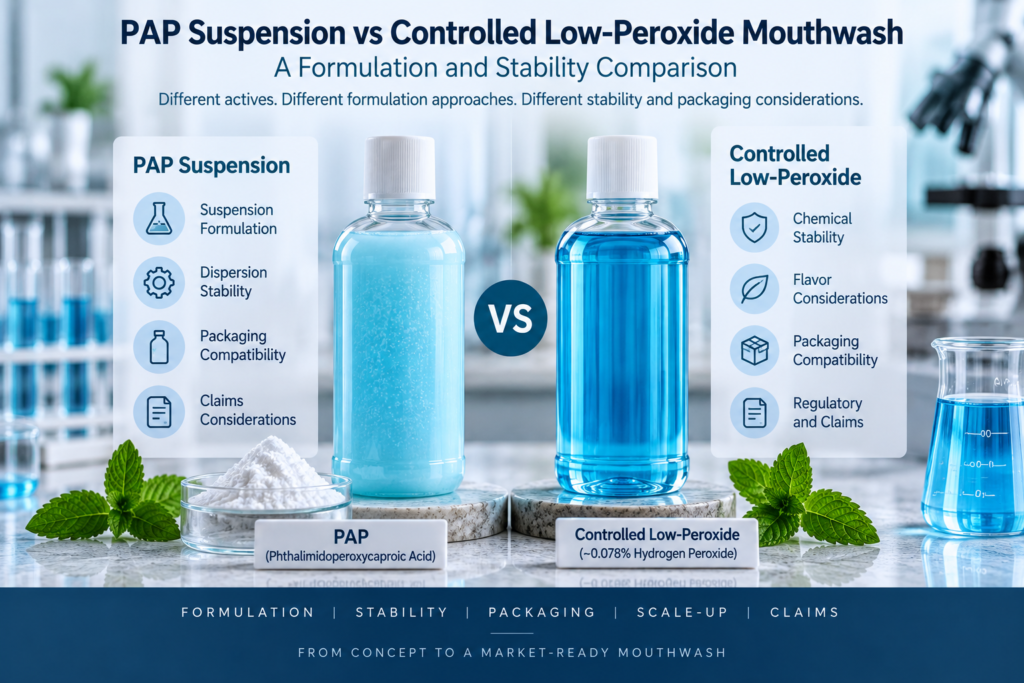
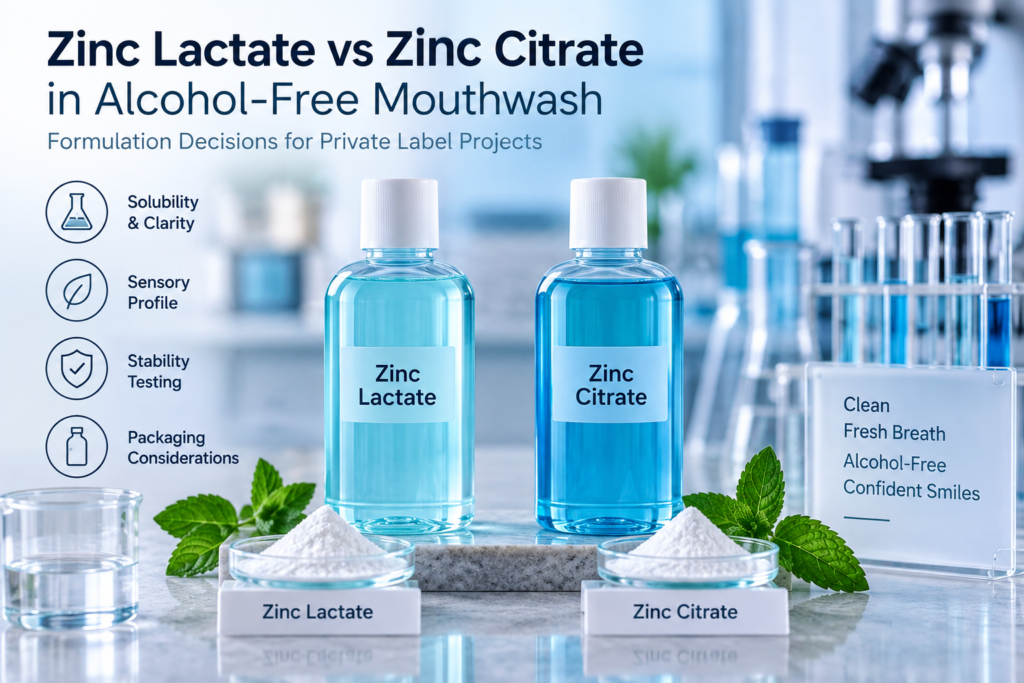
Yes, within a confirmed cosmetic mouthwash scope. Development may begin from a benchmark or a mature base and include flavor, sensory, appearance, active-system, and packaging adjustments. Current directions include standard alcohol-free mouthwash, Zinc Citrate + Xylitol, PAP suspension, and controlled low-peroxide systems. Final feasibility, testing, documentation, timing, and claims are confirmed for the actual project and destination market.
Prepare the destination market, expected first-order quantity, benchmark product, cosmetic positioning, formula direction, sensory target, preferred packaging, artwork status, and intended launch schedule. A more complete brief allows the manufacturer to evaluate fit before samples are prepared.
Due diligence is evaluating your supplier before asking for samples. That will prevent issues like product failures, launch delays, and costly stockouts.
Before qualifying a supplier, ensure they:
ORALABX coordinates formulation review, sampling, packaging, documentation, and commercial production through the qualified parties assigned to each project. The applicable formulation adviser, development support, sample execution, production facility, and document issuer are confirmed according to the actual scope.
We welcome qualification discussions before sampling so both sides can confirm the manufacturing scope, responsible parties, available documentation, commercial quantity, and approval process.
Ready to partner with a specialized oral care manufacturer that can deliver on schedule?
Contact the ORALABX team with your destination market, benchmark, formulation direction, packaging format, first-order quantity, and intended launch schedule.

Share your product type, target market, estimated volume and launch timeline. We will review the project scope and recommend the appropriate development path.
Best suited to brands, importers and distributors planning scalable commercial production.