In This Article
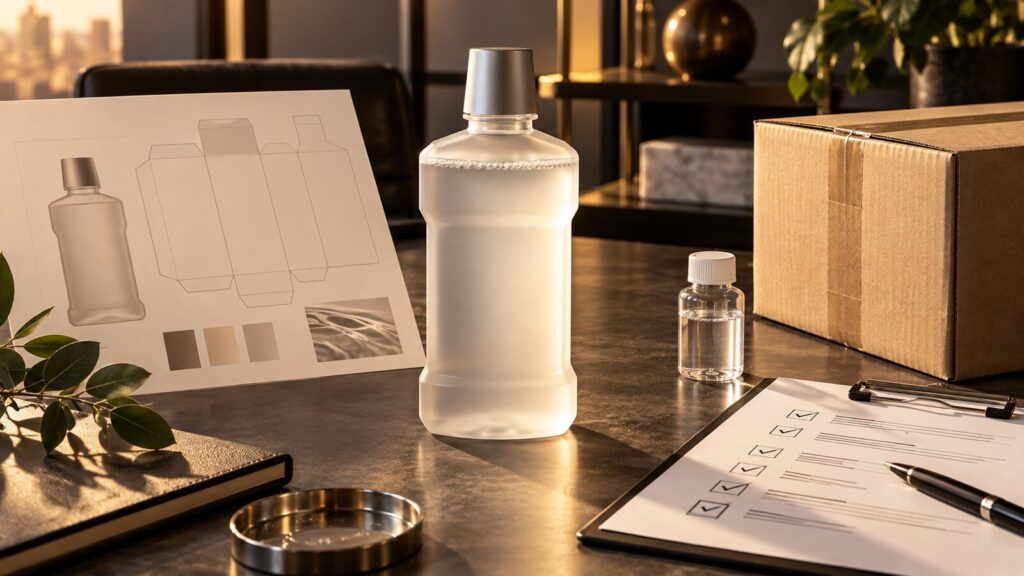
Mouthwash packaging is one of those decisions that carries a lot of weight once production starts. The format you choose affects filling line compatibility, MOQ, shipping stability, and how well your product holds up between the factory and whoever is receiving it on the other end.
Packaging decisions shape how your product gets filled, sealed, tested, and shipped. And if you get it wrong early, you are looking at costly changes later, sometimes after components have already been sourced.
In this article, we walk through the packaging formats commonly used in mouthwash production, the factors that influence which format makes sense for your situation, and the questions worth asking before you commit to anything.
Before you start comparing formats, it helps to get clear on your own situation first. A lot of buyers come to us with a format already in mind, and sometimes it is the right one. But sometimes it creates problems that could have been avoided if we had asked a few basic questions at the start—especially when working with a mouthwash contract manufacturer.
These are the questions you should ask yourself before you bring a format to your manufacturer:
Where you plan to sell your product should drive a significant part of your packaging conversation. This is something we always ask about early, because the same format that works perfectly for one channel can create real problems in another.
Here are the most common sales channels we work with and what each one means for your packaging format:
If you are selling through Amazon’s fulfillment network, your packaging needs to handle warehouse handling, extended storage, and last-mile shipping without failing.
Leakage is one of the most common issues we see with liquid products in FBA, and it usually comes down to closure performance and seal integrity not being tested properly before production.
Lightweight bottles also help keep your per-unit shipping costs down, which matters more the further you scale.
If your product is going onto retail shelves, your packaging needs to meet retailer specifications around bottle size, carton configuration, and shelf readiness—requirements that are closely tied to efficient mouthwash manufacturing.
Bottle height and label placement need to fit the planogram, and your secondary packaging needs to hold up through distribution without arriving damaged. Retailers will send products back if they do not meet these requirements, so it is worth building this into the conversation from the start.
If you are supplying hotels directly, or if you are a brand that sells into the hospitality sector, small-format and single-use packaging is usually what the channel requires. This is especially true for mouthwash manufacturing and packaging options applications, where consistency and presentation matter.
Hotels want portability and consistency across their amenity kits, which means lower fill volumes and formats that are easy to present in a room setting. Sachet Explore private label mouthwash packet manufacturing for printed-film, filling and repeat-supply planning.s or small bottles in the 30ml to 50ml range are the formats that make the most sense here.
If your product ships directly to the end consumer, your packaging needs to handle individual transit rather than pallet shipments. A bottle that survives a pallet drop may not survive being tossed around in a single courier box.
In this case, your secondary packaging and inner cushioning become just as important as the primary bottle itself.
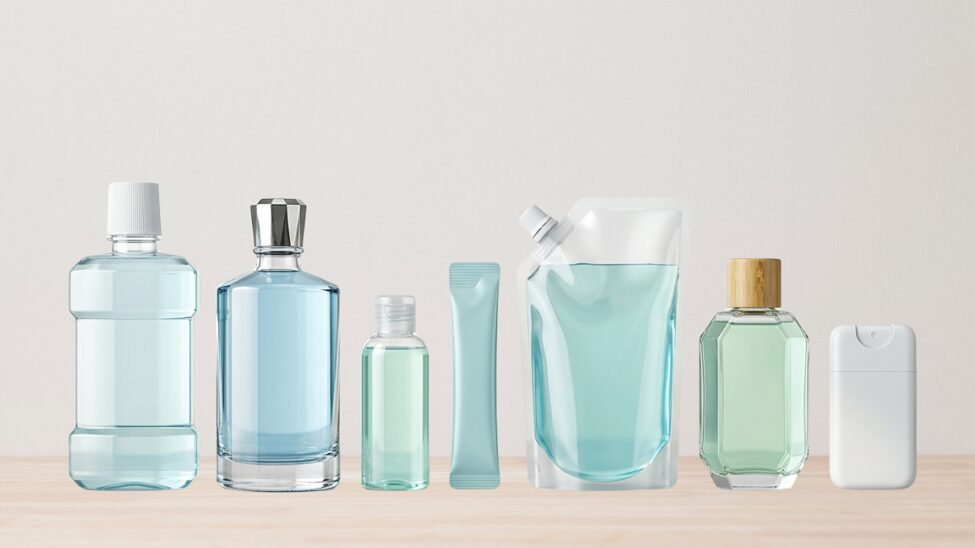
There are a few formats that come up consistently in mouthwash production. Each one has different filling requirements, component sourcing considerations, and production characteristics, and the right one for you depends on where your product is going and how it is going to be used.
These are the formats you will most likely encounter when discussing options with your manufacturer:
Standard HDPE or PET bottles are the most common format in mouthwash bottle packaging, and for good reason. They are compatible with most filling lines, available from a wide range of component suppliers, and straightforward to label and seal.
Fill volumes typically run from 250ml to 1,000ml depending on intended use. If you are starting out and want a format that gives you the most flexibility in production scheduling and throughput, this is usually where we recommend beginning.
Travel mouthwash packaging works with reduced fill volumes, usually between 50ml and 100ml. These smaller bottles require adjusted filling line settings and tighter leakage controls, since smaller closures under transit pressure are more prone to failure if they have not been properly tested.
They are a strong fit for travel retail, airline amenity kits, and Amazon FBA bundles where size and weight limits apply. You can see how these factors came together in a real production scenario in this travel mouthwash OEM case study.
Sachets require specialized filling equipment and are not compatible with standard bottle-filling lines, so if this is the format you are considering, it needs to come up early in the conversation.
Production throughput is lower than with bottles, and the component sourcing process is more involved. That said, they are well-suited to sampling programs, hotel amenity kits, and trial-size distribution where a single-use format is exactly what the end use case calls for.
Packaging and formulation are not separate decisions. What goes inside the bottle directly affects what the bottle needs to be made of, how it needs to be sealed, and how it will perform over time.
Alcohol-based or essential oil formulations may interact with packaging materials, making early compatibility testing essential—something any experienced oral care manufacturer should guide you through.
Essential oil-based formulations add another layer to this. Some oils degrade certain closure materials or affect how well the seal holds over time. This is why we conduct compatibility assessments as part of the development process, to confirm that the closure system, bottle material, and formulation all work together without compromising the product.
If you come to us with a formulation already developed, we will assess it against your preferred packaging before we move forward. And if you are still working on the formulation, that is actually the better time to have this conversation, because it gives us more flexibility to recommend options that work well together from the start.
Bottle size has implications beyond how much product a consumer gets per purchase. It affects filling line efficiency, freight costs, storage requirements, and how your product performs in transit. The right size depends on who you are selling to and how the product is going to reach them.
Here is how each size range plays out from a production and logistics perspective:
If you are targeting Amazon FBA, travel retail, or hospitality supply, travel-size bottles are likely what you need. Keep in mind that smaller formats come with tighter filling tolerances and more stringent leakage prevention requirements.
Production costs per unit also tend to run higher relative to larger formats, because the handling requirements do not scale down proportionally with the fill volume.
This is the most common range for consumer mouthwash products, and it is where production efficiency tends to be best. Standard fill volumes in this range are compatible with most filling lines, support higher throughput, and are what retailers and consumers are already familiar with. If you are unsure where to start, this range is usually the most practical entry point.
Best suited for wholesale and mouthwash bulk distribution, though it comes with heavier shipping weights and more demanding secondary packaging requirements. If you are planning to go this route, freight costs and warehouse storage space are worth factoring into your planning early.
Whether your product is going into retail or fulfillment, the physical dimensions of your bottle affect how efficiently it can be shipped and stored.
Bottle height and diameter determine how many units fit per shelf and per pallet, and your carton configuration needs to be planned around that. For FBA or direct-to-consumer fulfillment, your secondary packaging also needs to prevent leakage and protect the primary bottle through multiple handling points along the way.
There are things your manufacturer is thinking about when you present a packaging format that may not be obvious from the outside. These are operational considerations that directly affect your lead time, your production cost, and how smoothly your order moves through the facility.
When you bring a packaging format to the table, your manufacturer is evaluating it against these factors before confirming whether it is feasible for your timeline and budget.
These are the kinds of details that are worth discussing upfront, before you have committed to a format and a timeline that may not be compatible.
Packaging is one of the factors that can push your MOQ higher than you were expecting, and it is worth understanding why before you commit to a format.
Bottle suppliers carry their own minimum order quantities for components, and these minimums go up significantly for custom shapes, custom colors, or printed bottles. Decoration methods like shrink sleeves or direct printing come with print run minimums that feed directly into your overall MOQ. Specialized components, such as child-resistant closures or custom pump dispensers, add sourcing lead time and typically come with higher minimums as well.
If you are working with a tighter budget or want to start with a smaller initial order, stock packaging is usually the smarter starting point. Stock options carry lower component minimums and shorter lead times, which keeps your entry MOQ more manageable and gets your product to market faster.
If you want to explore what starting quantities look like for different private label mouthwash packaging configurations, requesting a sample kit is a practical first step before you commit to anything.
Before your mouthwash goes into production at scale, your manufacturer should be evaluating how the packaging performs under real-world conditions.
These are the areas your manufacturer should be covering with you during the development process.
Raising these points early in the conversation is the best way to avoid returns, rejections, or compliance issues after your product is already in the market.
Finalizing your components is a critical milestone in the production timeline. Before components are ordered, use this checklist to review the final steps of the OEM process with your manufacturer:
Yes, and this is one of the more common things buyers overlook. Alcohol content and essential oil ingredients can interact with certain plastic grades and closure materials in ways that affect product integrity over time. Compatibility assessments are a standard part of the development process for this reason.
They can, and they often do. Custom formats, printed packaging, and specialized components carry higher minimums at the component supplier level, which feeds into your overall MOQ. If keeping your MOQ low is a priority, stock packaging is the better starting point.
They require tighter filling tolerances and more rigorous leakage testing than standard bottles, but with the right production setup they are very manageable. The key is flagging the format early so the right equipment and testing protocols are in place before your production run.
Standard PET or HDPE bottles in daily-use fill volumes are the most common across the industry. Travel-size bottles and sachets are used for specific channels like hospitality supply, airline amenity kits, and sampling programs.
As early as possible. Packaging decisions affect formulation compatibility, component lead times, and MOQ. The later these conversations happen, the more limited your options become and the more expensive any changes get.
It is possible, but it usually means retesting for compatibility and waiting on new components to be sourced. It is significantly easier and less costly to get this right before production begins.
The right mouthwash packaging format is the one that:
There is no single answer that works for every brand, but there is a process for getting to the right one, and it starts with the right manufacturing conversation early enough to actually make a difference.
At ORALABX, we work with brands at the packaging selection stage, before formulation is locked and before components are sourced. That means you get input on compatibility, MOQ implications, lead times, and testing requirements from the start.
Don’t lock in your packaging until you’ve verified its manufacturing viability.
Contact the ORALABX team today to align your packaging strategy with your production budget, map out realistic lead times, and optimize your formulation compatibility before you source.
Let’s build a production-ready plan for your product.
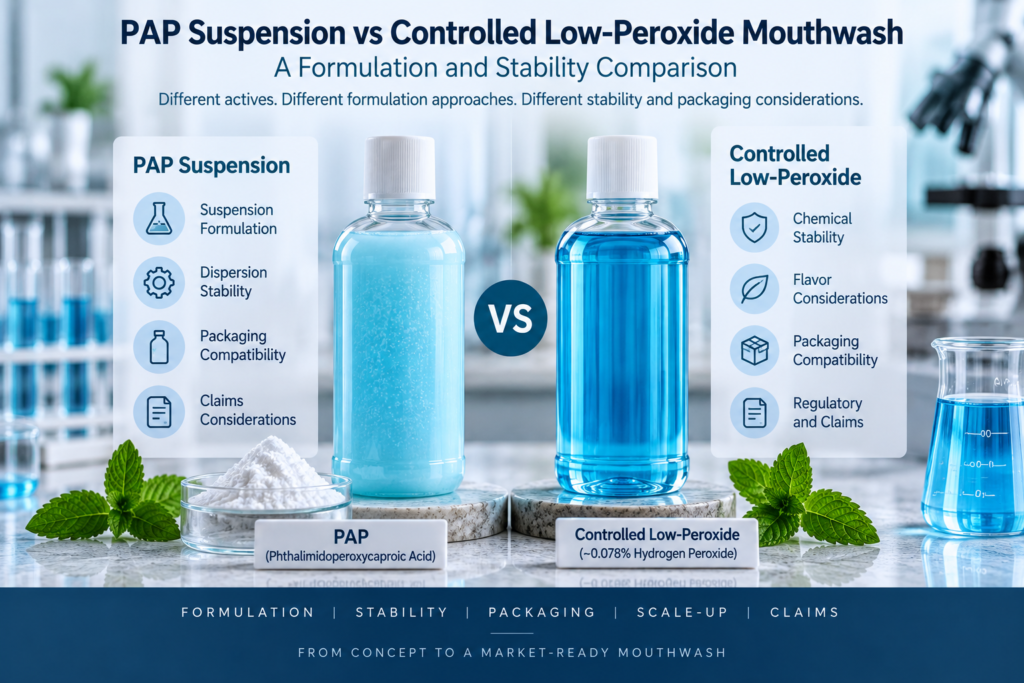
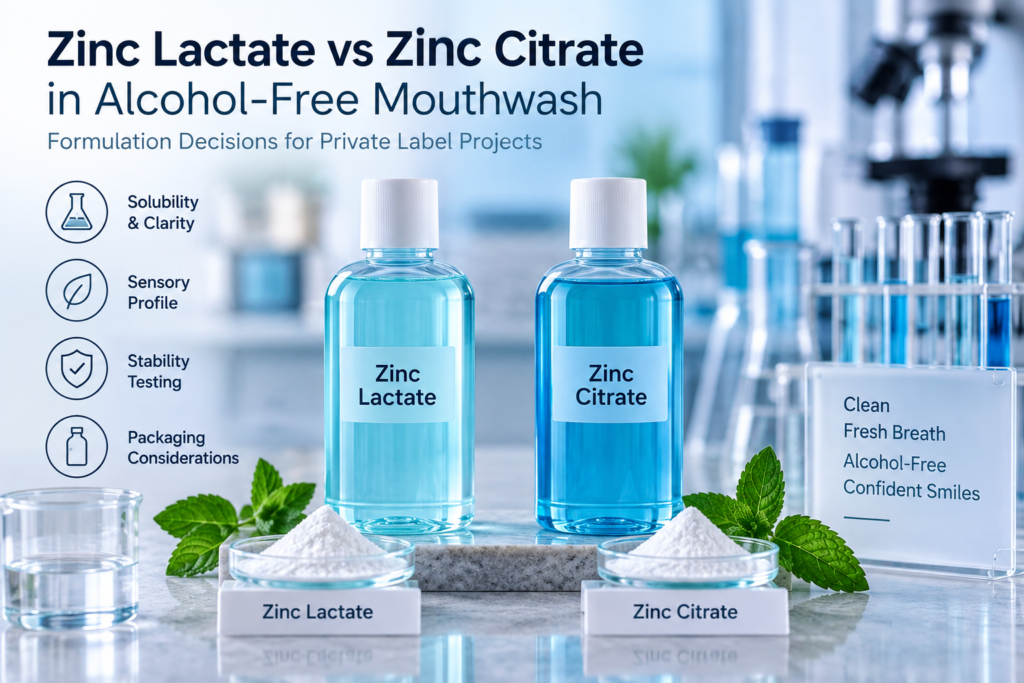
Packaging selection should follow the formula system rather than being treated as a purely visual decision. Zinc-based alcohol-free mouthwash may require attention to clarity, flavor retention, and interactions with the selected closure or liner. PAP suspension systems also need enough visual control to evaluate settling, re-dispersion behavior, and appearance throughout the observation period.
Controlled low-peroxide systems require particular care with bottle material, closure, liner, seal integrity, headspace, and storage conditions. Packaging that works for a conventional transparent mouthwash should not be assumed suitable without compatibility review.
Final packaging approval should be tied to the confirmed formula and intended commercial components. Review our oral care packaging capabilities and formulation process.

Share your product type, target market, estimated volume and launch timeline. We will review the project scope and recommend the appropriate development path.
Best suited to brands, importers and distributors planning scalable commercial production.